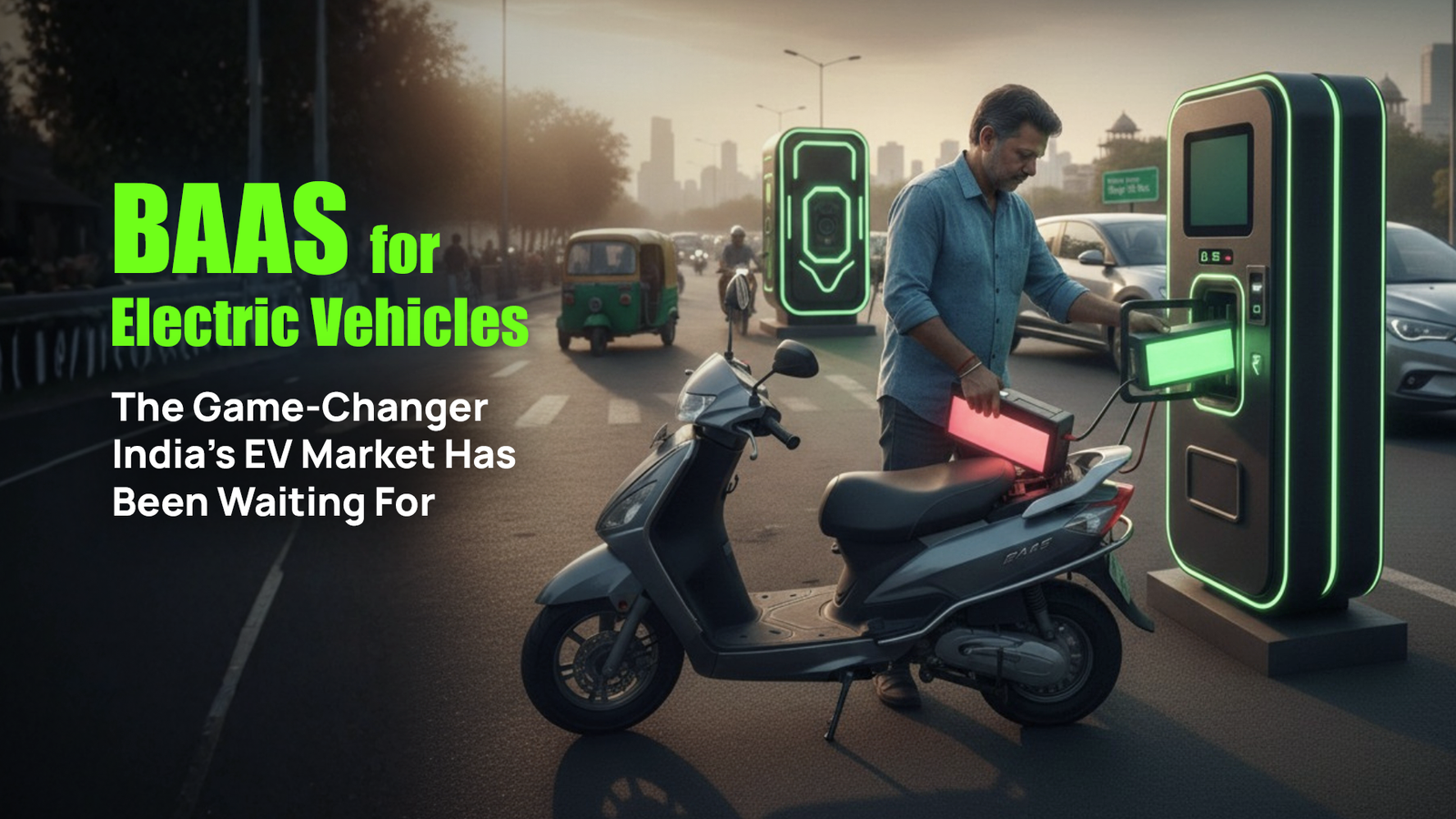
Battery costs make up nearly 35 to 45% of an electric vehicle’s total price. In India, that single factor has slowed mass EV adoption more than charging infrastructure or range anxiety.
This is where BAAS for electric vehicles, also known as Battery as a Service, is emerging as a serious game-changer.
Instead of purchasing the battery upfront, customers subscribe to it separately. That simple shift in ownership structure could dramatically lower EV prices and unlock faster adoption especially in price-sensitive markets like India.
What is BAAS for Electric Vehicles?
Battery as a Service (BAAS) is a business model where the battery is separated from the vehicle purchase. The buyer owns the EV, but the battery is leased or subscribed under a service agreement.
In practical terms:
- You buy the electric vehicle at a lower upfront cost
- The battery is provided under a subscription or pay-per-use plan
- Battery health, replacement, and performance are managed by the service provider
By removing the most expensive component from the vehicle’s sticker price, BAAS for electric vehicles makes EV ownership more accessible.
Why India Is a Natural Market for BAAS
India’s EV ecosystem has grown steadily, supported by incentives such as FAME II. But subsidies alone cannot bridge the affordability gap.
Battery as a Service addresses four key challenges in the Indian EV market:
- High Upfront EV Cost
Separating the battery reduces the initial purchase price significantly, particularly in two-wheelers and three-wheelers.
- Battery Degradation Concerns
Many buyers hesitate because of battery lifespan uncertainty. Under a BAAS model, the service provider takes responsibility for maintenance and replacement.
- Operational Downtime for Fleets
Fleet operators prioritize uptime. Battery swapping integrated with BAAS minimizes charging delays.
- Predictable Operating Expenses
Instead of heavy capital expenditure, users shift toward a more manageable operational expense model.
In a market where affordability drives decisions, BAAS directly solves the biggest friction point.
How Battery Swapping Supports BAAS
Battery swapping infrastructure is central to the success of BAAS for electric vehicles.
Companies such as SUN Mobility have developed swapping networks that allow depleted batteries to be exchanged in minutes. Meanwhile, Bounce Infinity introduced electric scooters designed for removable batteries under subscription models.
For high-usage vehicles such as delivery scooters and cargo three-wheelers, this model reduces downtime and improves daily revenue potential.
Policy Push: Is the Government Backing BAAS?
Regulatory clarity plays a critical role in scaling Battery as a Service in India.
In 2022, NITI Aayog released a draft battery swapping policy framework. The focus was on interoperability standards, safety regulations, and ecosystem alignment.
Standardization is essential. Without common battery specifications, swapping networks cannot scale efficiently across manufacturers.
The policy signals that BAAS is not an experimental concept — it is becoming part of India’s long-term EV strategy.
BAAS vs Traditional Charging: Which Model Wins?
The debate is often framed incorrectly. BAAS for electric vehicles is not competing with traditional charging; it complements it.
Battery swapping and BAAS are best suited for:
- Two-wheelers and three-wheelers
- Commercial fleets
- Urban mobility services
- High-utilization vehicles
Home and public charging remain ideal for private passenger EV users with predictable driving patterns.
India’s EV future is likely hybrid — combining charging infrastructure with Battery as a Service solutions.
Challenges Slowing BAAS Adoption
Despite its advantages, BAAS for electric vehicles still faces structural challenges:
- Limited battery standardization across OEMs
- High capital investment for swapping infrastructure
- Consumer trust and awareness gaps
- Pricing transparency concerns
Interoperability remains the biggest hurdle. Until battery formats become standardized, scaling nationwide networks will remain complex.
However, as adoption grows, market consolidation and strategic partnerships are expected to accelerate infrastructure expansion.
The Business Opportunity Behind BAAS
Beyond affordability, Battery as a Service opens new revenue models.
For OEMs and energy companies, BAAS creates:
- Recurring subscription income
- Data-driven fleet intelligence
- Energy storage integration opportunities
- Long-term customer engagement
Instead of a one-time vehicle sale, companies build ongoing service relationships.
For investors and policymakers watching India’s EV transformation, BAAS represents more than a pricing model it represents structural change
The Road Ahead for BAAS in India
India’s EV growth will depend on affordability, infrastructure scalability, and consumer confidence.
BAAS for electric vehicles addresses all three.
As adoption expands beyond metro cities into Tier 2 and Tier 3 markets, lowering upfront costs will become even more critical. Battery as a Service could be the lever that drives the next wave of electric mobility growth.
The question is no longer whether BAAS will play a role in India’s EV ecosystem.
The real question is how quickly the industry can standardise, scale, and earn consumer trust.