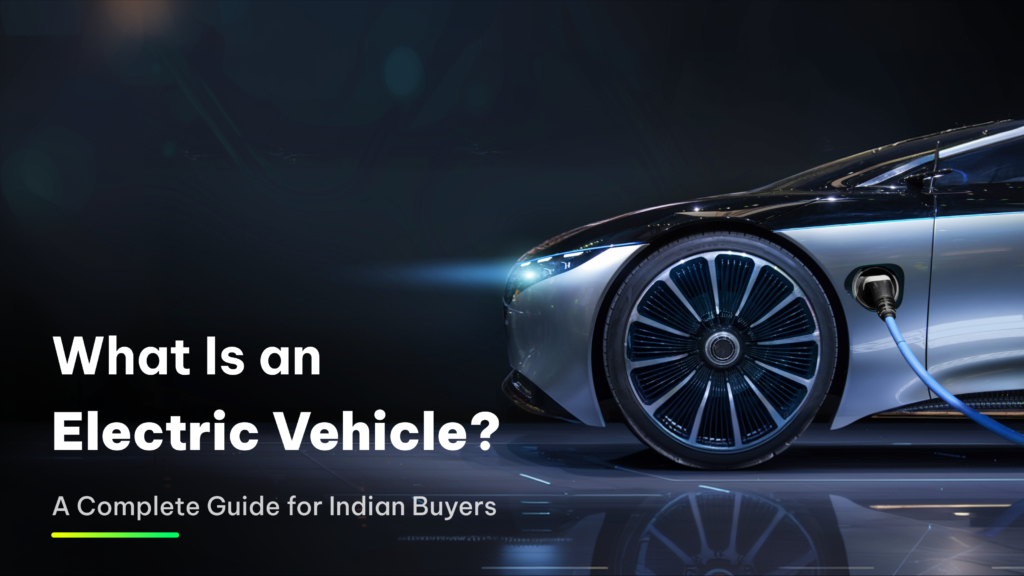
An electric vehicle (EV) is any vehicle that uses one or more electric motors powered by a rechargeable battery pack as its primary propulsion source replacing or supplementing the conventional internal combustion engine (ICE) that burns petrol or diesel. In simple terms: instead of filling up at a fuel station, you plug in. Instead of an engine with hundreds of moving parts, you have a motor with a fraction of the complexity.
India’s EV market crossed 20 lakh annual unit sales in FY2025, growing over 40% year-on-year. From two-wheelers and auto-rickshaws to sedans, SUVs, buses, and trucks electric powertrains are now available across every vehicle category in the country. For a first-time buyer trying to understand what this shift actually means, this guide starts from the beginning.
How an Electric Vehicle Works: The Basics
Every electric vehicle runs on the same fundamental principle: electrical energy stored in a battery pack is converted into mechanical energy by an electric motor, which drives the wheels. When you press the accelerator, the motor controller adjusts how much current flows from the battery to the motor, increasing or decreasing speed instantly, with no gears and no clutch.
One of the most important features of EVs is regenerative braking. When you lift off the accelerator or press the brake, the motor reverses its function and acts as a generator converting kinetic energy back into electrical energy and feeding it back into the battery. This is why EVs are highly efficient in stop-go city traffic: energy that would otherwise be lost as heat in conventional brakes is partially recovered. In Indian urban conditions, regenerative braking can recover 15–25% of energy that would otherwise be wasted.
Types of Electric Vehicles Available in India
Not all EVs are the same. The Indian market currently offers four main categories:
Battery Electric Vehicles (BEVs) run entirely on electricity. They have no petrol or diesel engine, no exhaust pipe, and zero tailpipe emissions. Examples in India: Tata Nexon EV, Mahindra BE 6, MG Windsor EV, Ola S1 Pro, Ather 450X. These are the vehicles most people mean when they say ‘EV.’
Hybrid Electric Vehicles (HEVs) use both a petrol engine and an electric motor. The battery charges itself through regenerative braking and the engine you never plug in. The electric motor assists the engine during acceleration, improving fuel efficiency. Examples: Toyota Innova Hycross, Maruti Grand Vitara Hybrid. These are not plug-in vehicles and are often called ‘self-charging hybrids’ in Indian marketing.
Plug-in Hybrid Electric Vehicles (PHEVs) have both a petrol engine and a larger battery that can be charged from an external power source. They can run for 30–80 km on pure electric power before switching to petrol. PHEVs are currently limited in India but are gaining traction globally.
Fuel Cell Electric Vehicles (FCEVs) generate electricity onboard from hydrogen, emitting only water vapour. These are at a very early stage commercially and not yet available for personal purchase in India.
For most Indian buyers in 2026, the relevant choice is between a BEV (full electric, plug-in) and an HEV or petrol car. This guide focuses primarily on BEVs.
Key Components of an EV You Should Know
The battery pack is the most critical and expensive component of any EV. It stores electrical energy in lithium-ion cells and typically accounts for 30–40% of the vehicle’s cost. Battery capacity is measured in kilowatt-hours (kWh) the higher the kWh, the more energy stored and the greater the range. Most Indian EVs available today carry packs ranging from 26 kWh (Tata Tiago EV, ~250 km range) to 79 kWh (Mahindra XEV 9e, ~500+ km range).
The electric motor converts stored electrical energy into rotational force (torque) to drive the wheels. Unlike petrol engines that need to build RPM before delivering peak torque, electric motors deliver maximum torque from a standstill which is why EVs feel noticeably quicker and smoother off the line in city traffic.
The onboard charger (OBC) is the component inside the vehicle that converts AC power from the grid into DC power the battery can store. Its capacity (measured in kW) determines how fast you can charge at home or at an AC public charger. The Battery Management System (BMS) monitors cell temperature, voltage, and state of charge protecting the battery from overcharging, deep discharge, and thermal damage.
How India Is Adopting Electric Vehicles
India is one of the fastest-growing EV markets globally, driven by a combination of high petrol prices, government policy support, and rapidly expanding domestic manufacturing. The Government of India’s FAME-II scheme, PM-E-DRIVE programme, and GST reduction on EVs (5% versus 28% on ICE vehicles) have made EVs significantly more accessible. State-level incentives in Maharashtra, Delhi, Gujarat, and Tamil Nadu add further purchase subsidies and road tax exemptions in many cases.
Two-wheelers and three-wheelers have led India’s EV adoption together accounting for over 90% of EV sales in FY2025. The passenger car segment is growing rapidly, with Tata Motors commanding approximately 60% of the electric car market, followed by MG, Mahindra, and Hyundai. India has set a target of 30% EV penetration across all vehicle categories by 2030.
Is an Electric Vehicle Right for You?
An EV makes clear practical and financial sense if you drive regularly within a city, have access to charging at home or at your workplace, and plan to keep the vehicle for at least 3–4 years. The math is straightforward: running cost savings of ₹5,000–10,000 per month for moderate commuters, combined with lower maintenance, typically offset the higher upfront price within 3–5 years.
If you frequently travel long distances between cities, live in an area with limited charging infrastructure, or need a vehicle under ₹7 lakh, the calculus is more nuanced. The honest answer is that India’s EV ecosystem is still maturing. It is genuinely excellent for urban use cases and improving steadily for everything else. Understanding exactly where you fit in that landscape is the most important first step.
FAQs
Lorem ipsum dolor sit amet, consectetur adipisicing elit. Optio, neque qui velit. Magni dolorum quidem ipsam eligendi, totam, facilis laudantium cum accusamus ullam voluptatibus commodi numquam, error, est. Ea, consequatur.
Lorem ipsum dolor sit amet, consectetur adipisicing elit. Optio, neque qui velit. Magni dolorum quidem ipsam eligendi, totam, facilis laudantium cum accusamus ullam voluptatibus commodi numquam, error, est. Ea, consequatur.