If you’ve explored EV charging options in India, you’ve likely come across terms like AC charging, DC fast charging, Level 2 chargers, and CCS2 connectors. While these may seem technical, the core concept is straightforward.
Understanding the difference between AC and DC charging is essential because it directly affects charging speed, cost, battery health, and overall convenience. This guide simplifies the concepts and helps you choose the right charging approach based on real-world Indian usage.
How EV Charging Works: The Basics
All electric vehicles store energy in the form of DC (direct current). However, the electricity supplied from the grid whether at home or public stations is AC (alternating current).
This creates a necessary step: conversion.
Every EV is equipped with an onboard charger (OBC), which converts AC power into DC power before storing it in the battery.
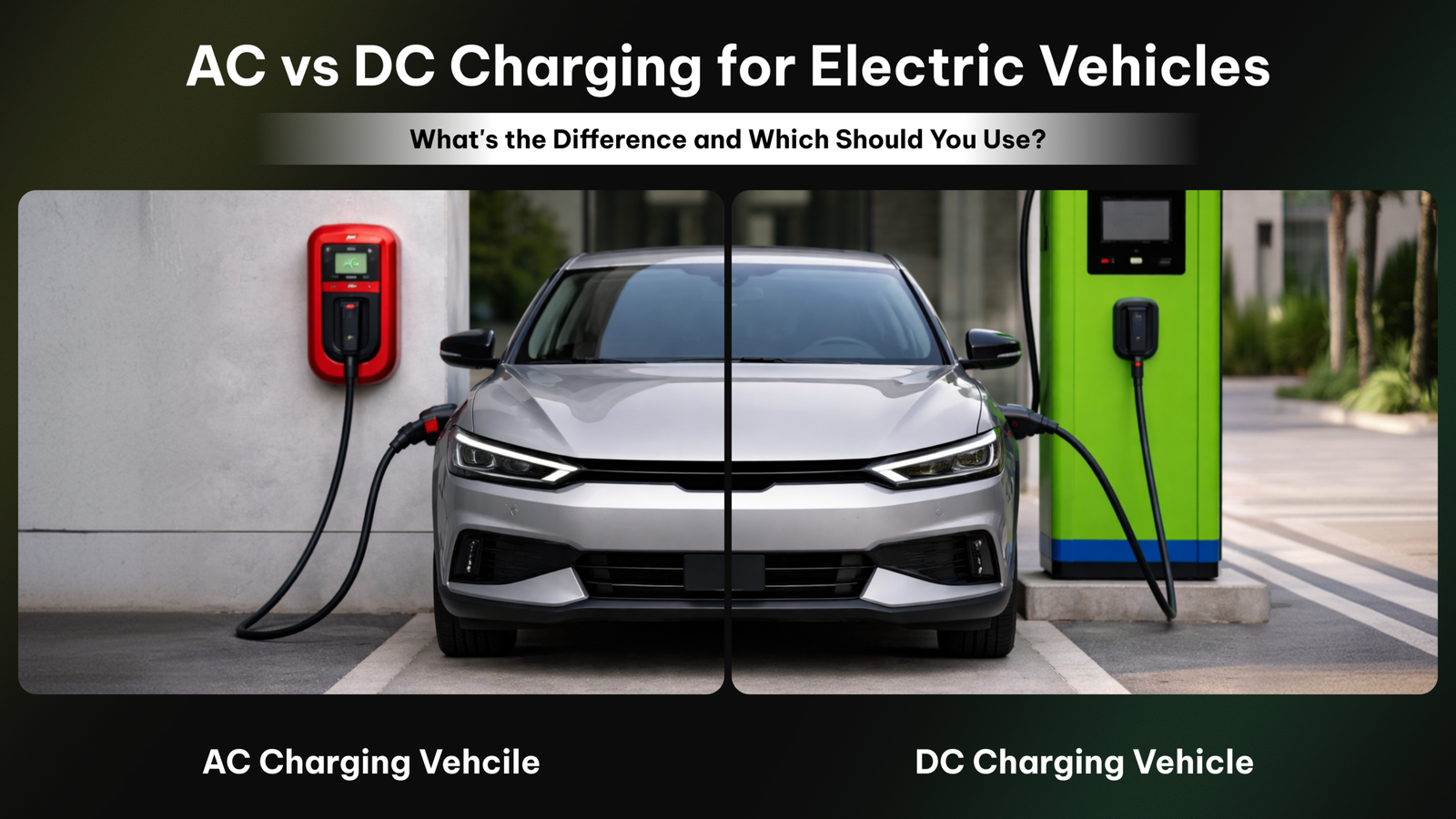
In AC charging, this conversion happens inside the vehicle
In DC fast charging, the conversion happens inside the charging station
This is why DC chargers are significantly larger, more powerful, and more expensive. They handle high-speed energy conversion externally and deliver DC power directly to the battery.
AC Charging (Level 1 and Level 2): What It Is and When to Use It
AC charging is the most common and practical method for everyday EV usage in India.
Level 1 AC Charging (Basic Home Charging)
Level 1 charging uses a standard 15A household socket and typically delivers 1.5–2.4 kW of power. This translates to approximately 10–15 km of range per hour.
It is suitable for:
Small battery vehicles
Two-wheelers and entry-level EVs
Users with low daily driving requirements
However, for larger battery EVs, this method can feel slow.
Level 2 AC Charging (Wallbox Charging)
Level 2 charging uses a dedicated wallbox charger, typically ranging from 3.3 kW to 7.2 kW in Indian households.
At 7.2 kW, which is the most common setup:
A 40 kWh EV can charge from 20% to 80% in about 5–6 hours
Ideal for overnight charging
This method offers the perfect balance between speed, cost, and battery health.
Why AC Charging Is Ideal for Daily Use
Lower electricity cost (₹7–10 per unit)
Minimal battery stress
Convenient for overnight charging
Widely accessible at homes and workplaces
Insight:
AC charging is the foundation of EV ownership in India, it handles 80–90% of typical charging needs.
DC Fast Charging (Level 3): Speed Comes with Trade-Offs. DC fast charging is designed for speed and convenience, especially during travel.
Unlike AC charging, DC chargers bypass the vehicle’s onboard charger and supply DC electricity directly to the battery. This eliminates conversion delays and allows significantly faster charging speeds.
Charging Speed and Power Levels
In India, DC fast chargers typically operate at:
30 kW (common public chargers)
50–60 kW (standard fast chargers)
120 kW and above (premium high-speed networks)
A 50 kW charger can charge a mid-size EV from 20% to 80% in around 55–65 minutes. Higher-capacity chargers can reduce this time to under 30 minutes for compatible vehicles.
Cost and Practical Usage
DC fast charging is more expensive than home charging:
₹18–25 per unit compared to ₹7–10 for AC charging
This makes it less suitable for daily use and more appropriate for:
Highway travel
Emergency top-ups
Time-sensitive situations
Battery Impact
The key trade-off with DC fast charging is heat generation.
Higher power input increases battery temperature, which can accelerate long-term degradation if used excessively. While occasional use is completely safe, relying on fast charging daily can impact battery lifespan.
Insight:
DC fast charging is a convenience feature – not a primary charging solution.
AC vs DC Charging: A Direct Comparison
Factor | AC Charging | DC Fast Charging |
Conversion | Inside vehicle (OBC) | Inside charging station |
Power Output | 3.3–22 kW | 30–240+ kW |
Charging Time (40 kWh battery) | 5–8 hours | 40–70 minutes |
Cost per Unit | ₹7–10 | ₹18–25 |
Battery Impact | Low (battery-friendly) | Moderate (heat generation) |
Use Case | Daily charging | Travel and quick top-ups |
Connectors in India | Type 2, Bharat AC-001 | CCS2, Bharat DC-001 |
Which Charger Type Is Right for You?
Choosing the right charging method depends on your daily routine, usage pattern, and infrastructure access.
Use AC Charging as Your Primary Method
AC charging should be your default choice because:
It is the most cost-effective
It preserves battery health
It fits seamlessly into overnight routines
Installing a Level 2 wallbox charger is highly recommended if your vehicle supports it. The one-time installation cost typically between ₹5,000 and ₹12,000 pays off in convenience and faster charging.
Use DC Fast Charging Strategically
DC fast charging should be used when:
You are on long highway trips
You need a quick recharge during the day
Time is a critical factor
However, it should not replace your daily charging routine.
Ideal Charging Strategy (Balanced Approach)
Daily use → AC charging at home or workplace
Occasional need → DC fast charging
This hybrid approach ensures:
Lower costs
Better battery health
Maximum flexibility
Quick Summary:
A smart EV charging strategy in India is to use AC charging for your regular daily needs and reserve DC fast charging for urgent situations or long-distance travel. AC charging is generally more affordable, gentler on the battery, and ideal for overnight home charging or workplace top-ups. On the other hand, DC fast charging offers quick power when time is limited, making it perfect for highway trips and emergency charging stops. By balancing both options wisely, EV owners can reduce charging costs, maintain better battery health, and enjoy greater convenience. This approach helps maximize battery life while ensuring the vehicle remains ready for both everyday commutes and occasional long journeys.