This article is for educational purposes and general guidance only. It’s not personalised financial advice. Loan rates, subsidies, and tax rules can change. Confirm current figures with your bank/NBFC and a tax advisor before deciding.
Looking at the 2026 scenarios, paying cash (or a very high down payment) still saves more money over five years than taking a standard electric vehicle car loan, even with SBI’s green car loan rates. But if your cash earns very low returns or you qualify for a special low‑rate scheme (like Gujarat’s 5% interest subsidy on EV loans), a loan can be close to neutral or even slightly better in some cases.
This article walks through the actual electric car cost in India, explains how 2026 subsidies change electric vehicle prices, and gives you a simple way to decide between an EV Financing and paying cash for your next EV vehicle purchase without getting lost in spreadsheets.
Why Subsidies Matter, Now More Than Ever
Before you start comparing loan interest versus cash, you must know your effective on‑road price, because 2026 subsidies are the biggest cost reducer for electric vehicles and upcoming EV models.
Under the current central EV incentive framework (FAME II/its continuation), the private EV car buyers do not receive a ₹10,000/kWh subsidy. Instead of upfront purchase incentives, they benefit from a significantly reduced 5% GST rate.
Central incentives for cars are modest compared to other e vehicles, like scooters are structured as per DWG/Department of Heavy Industry guidelines. Exact amounts vary by model and must be checked on the official portal or with the dealer.
State‑wise Highlights (2026)
Among states, Delhi, Gujarat, and Maharashtra currently offer the highest direct cash subsidies for 3‑wheel ev auto models (up to around ₹1.5 lakh in some cases).
States like Telangana and Tamil Nadu focus on 100% road tax and registration fee waivers rather than large cash subsidies for cars.”
Others like Assam have limited or model-specific incentives for 2 seater electric cars and larger three wheel electric car variants.
In many states, 100% road tax and registration fee waivers can save you anywhere from around ₹1 lakh to ₹1.8 lakh for a ₹15 lakh electric car, depending on the state’s tax rate.
Example:
Let’s look at a realistic scenario from 2026. Assume an ex‑showroom price for an electric vehicle car in Gujarat is ₹15,00,000.
ASSUMPTIONS:
- Central incentive:
For 4‑wheelers, the current central scheme does not give a subsidy of ₹10,000/kWh anymore. For passenger top rated electric cars, the central support is much lower and model‑specific. To keep the example simple, assume a central incentive of ₹50,000 (check your model’s exact figure with the dealer or official portal).
- State subsidy (Gujarat):
You qualify for the maximum Gujarat state subsidy of ₹1.5 lakh for 4‑wheel ev vehicles (subject to model caps, eligibility windows, and per‑buyer limits).
- Road tax & registration:
These are fully waived, which for a ₹15 lakh electric car could save around ₹1.2-₹1.5 lakh, depending on the state.
A conservative effective on‑road price could then be around:
15,00,000 − 50,000 − 1,50,000 = 13,00,000
(If you also get a full road tax + registration waiver, the final on‑road price could be closer to ₹11.5 – ₹12.5 lakh, depending on the exact tax rate.)
This example is a best‑case, fully‑eligible scenario; many buyers will get less than the maximum state subsidy or a smaller central benefit on upcoming EV models.
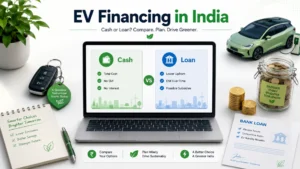
Cash vs Electric Vehicle Loan Comparison (with conservative subsidies)
Cash option:
If you pay cash, you simply pay the effective on‑road price (say ₹12,50,000 in this best‑case example) today. There is no interest, no loan fees, and no compounding cost over time.
Loan option:
Take a 5-year electric car loan, say SBI’s Green Car Loan at 8.5% (indicative only).
- Down payment: 20% of ₹12,50,000 = ₹2,50,000
- Loan amount: ₹10,00,000
- Tenure: 60 months
- EMI: ₹20,400 – ₹20,600 approximately
- Total EMIs over 5 years: ₹12,30,000 approximately
- Pure interest component: ₹2,30,000 approximately
Total outflow = Down payment + EMIs = ₹2,50,000 + ₹12,30,000 = ₹14,80,000.
That’s about ₹2.3 lakh more than the cash option of ₹12,50,000, even after assuming generous subsidies on top rated electric cars.
Takeaway:
Without a special interest subsidy, a standard 5‑year EV loan at 8-9% usually costs more than cash once subsidies are factored in.
(Actual rates depend on your credit profile, loan size, and tenure. Confirm with SBI or your NBFC before deciding.)
When Does an Electric Vehicle Loan Actually Become Worth It?
There are a few situations where a loan can be close to neutral or even slightly better for you as an electric vehicle buyer.
- Your cash earns very low returns
If your cash is sitting in a regular savings account earning 3%-4%, and you borrow at 8.5%, you are effectively losing 4.5%-5.5% per year on that money. In such a case, a loan is not “saving” money in absolute terms, but it gives you liquidity while you are losing on the spread.
- An interest subsidy on the loan
Some states offer interest subvention or loan subsidies for EV vehicles (terms vary). Check your state’s transport department or EV policy portal for current details.
- Tax benefits under Section 80EEB
Section 80EEB allows a deduction of up to ₹1.5 lakh on EV loan interest for loans sanctioned within the eligible period (originally 1 April 2019–31 March 2023, subject to government extensions). Whether it applies to a 2026 loan depends on the latest tax rules. Confirm with a tax advisor.
If your cash is sitting in a regular savings account earning 3%-4%, and you borrow at 8.5%, you are effectively losing 4.5%-5.5% per year on that money.
This assumes that your cash is in low-return instruments like savings accounts. If your cash is in FDs or other investments earning closer to or above the loan rate, the opportunity cost gap shrinks for e vehicles.
‘Cash wins’ is true if your marginal return on cash is lower than the loan rate and you don’t need the liquidity. If you can invest that cash at higher returns or need it for business/emergencies, a loan can be justified even if it’s slightly more expensive in pure interest terms.
A Simple Way to Decide for Yourself
| EV Cash | EV Loan |
| No interest cost at all | Interest cost adds to total price |
| Total outflow = effective on‑road price only | Total outflow = down payment + all EMIs (usually higher) |
| Best if you can pay 20–30%+ without financial stress | Best if paying cash would leave you cash‑starved |
| Best if you have no high‑interest debts | Risky if you already have high‑interest debts |
| Best if your marginal return on cash is lower than the loan rate | Good if you can invest that cash at higher returns than the loan rate |
| Best if loan rate is high (e.g., >7%) with no subsidy | Good if a state interest subsidy (if applicable) lowers effective rate |
| No EMI stress, immediate full ownership | Monthly EMI commitment for the tenure |
| No processing fees or pre‑closure charges | Processing fees and possible pre‑closure charges apply |
| Ties up your liquidity / cash reserves | Preserves liquidity for emergencies or better investments |
| Simple, no paperwork or approval needed | Requires loan approval, documentation, EMI tracking |
| Choose when: loan outflow exceeds cash cost by 10–15%+ | Choose when: loan is cheap (subsidized) or cash is needed for safety/growth |
Practical Tips Before You Apply for an Electric Vehicle Loan
Don’t chase the lowest EMI only
A longer tenure reduces the monthly payment but increases the total interest you pay on your electric car loan. For EV vehicles, a tenure of 3-4 years is usually better than 5, unless you really need a lower EMI to fit your budget.
Check processing fees and hidden charges
Some NBFCs offer slightly lower interest rates but higher processing fees or insurance bundling. Always ask for an all‑in cost sheet that includes interest, fees, and GST on fees, so you can compare lenders fairly for your electric vehicle prices.
Ask about state interest subsidy (if applicable)
Some states offer interest subvention or loan subsidies for electric vehicles, but terms vary widely. If your state advertises such a scheme, confirm:
- Eligibility criteria
- Caps on subsidy amount or loan size
- Whether the benefit is applied directly by the bank or claimed later through the state nodal agency.
Do not assume a specific “5% Gujarat interest subsidy” unless you can confirm it from an official source.
Capture tax benefits if you qualify
If you file under the Old Tax Regime and if your loan is within the eligible period under Section 80EEB, you may claim a deduction of up to ₹1.5 lakh on EV loan interest. Whether this applies to new 2026 loans depends on the latest tax rules; confirm with a tax advisor before assuming this benefit.
Use an EMI calculator before signing
Most banks and NBFCs like SBI, HDFC, Axis, and Tata Capital have online EMI calculators. Plug in your loan amount, interest rate, and tenure, and compare at least two or three lenders to see which one gives you the best total cost, not just the lowest EMI.
Should You Buy an EV with Cash or a Loan in 2026?
In 2026, paying cash or a high down payment still usually saves more money than taking a 5‑year EV loan at standard bank rates, even after central and state subsidies on electric cars.
A loan becomes a reasonable choice only if:
- You get a special low‑rate scheme (if your state offers interest subvention),
- Your cash is earning very low returns and you need liquidity, or
- You simply cannot afford a large down payment.
For most everyday buyers, the smarter path is:
Effective price of electric vehicles after subsidies ➡️ Biggest comfortable down payment ➡️ Shortest feasible loan tenure ➡️ Compare total interest cost versus cash.
That is the money‑smart way to choose between an EV loan and paying cash in 2026.
If you want a clearer, personalised view of your options on electric vehicle prices in India, you can explore EV cost calculators, subsidy guides, and loan comparisons tailored to your city and vehicle on
Brainy EV.
Our team breaks down the math in a much simpler and practical manner so you can make a confident decision without getting lost in any technical jargon about your electric vehicle’s price.
FAQs
1.Is it better to pay cash or take an EV loan in 2026?
In most cases, cash is financially better for electric vehicle purchases. A standard 5‑year EV loan at 7-9% interest usually costs more in total interest than you’d earn keeping that cash invested elsewhere. A loan becomes close to neutral only if you get a special interest subsidy (if your state offers one) or if you need liquidity for higher‑return investments.
2.What is PM E‑DRIVE and how does it affect me?
The PM E-DRIVE (Prime Minister Electric Drive Revolution in Innovative Vehicle Enhancement) is a ₹10,900 crore central scheme offering upfront purchase subsidies on electric two-wheelers (till July 2026), three-wheelers (till March 2028), and commercial EVs, while heavily funding public charging stations. It replaces the earlier FAME program. If you are buying an electric scooter, motorcycle, or 3-wheeler (like an e-rickshaw), you can get a subsidy of ₹2,500 per kWh of battery capacity, capped at ₹5,000 for 2-wheelers and ₹12,500 for 3-wheelers.
3.Which state gives the highest EV subsidies in 2026?
Delhi, Gujarat, and Maharashtra currently offer the highest direct cash subsidies for 4‑wheelers (up to around ₹1.5 lakh to ₹2 lakh in some cases). Delhi also adds a scrappage bonus. Many states, including Telangana and Tamil Nadu, focus more on 100% road tax and registration fee waivers rather than large cash subsidies for cars.
4.Can I claim tax benefit on EV loan interest in 2026?
Under Section 80EEB, a deduction of up to ₹1.5 lakh on interest paid is available, but it applies to loans sanctioned within the eligible period (originally 1 April 2019 to 31 March 2023, subject to government extensions). For new 2026 loans, you must check the current eligibility before assuming this benefit applies.
5.Does taking an EV loan reduce my overall cost compared to cash?
Generally, no, unless you land a special interest subsidy (if applicable) or your cash is earning very low returns. Over 3-5 years, total loan interest typically outweighs the opportunity cost of keeping that cash invested elsewhere, especially if your investments earn close to or more than the loan rate.