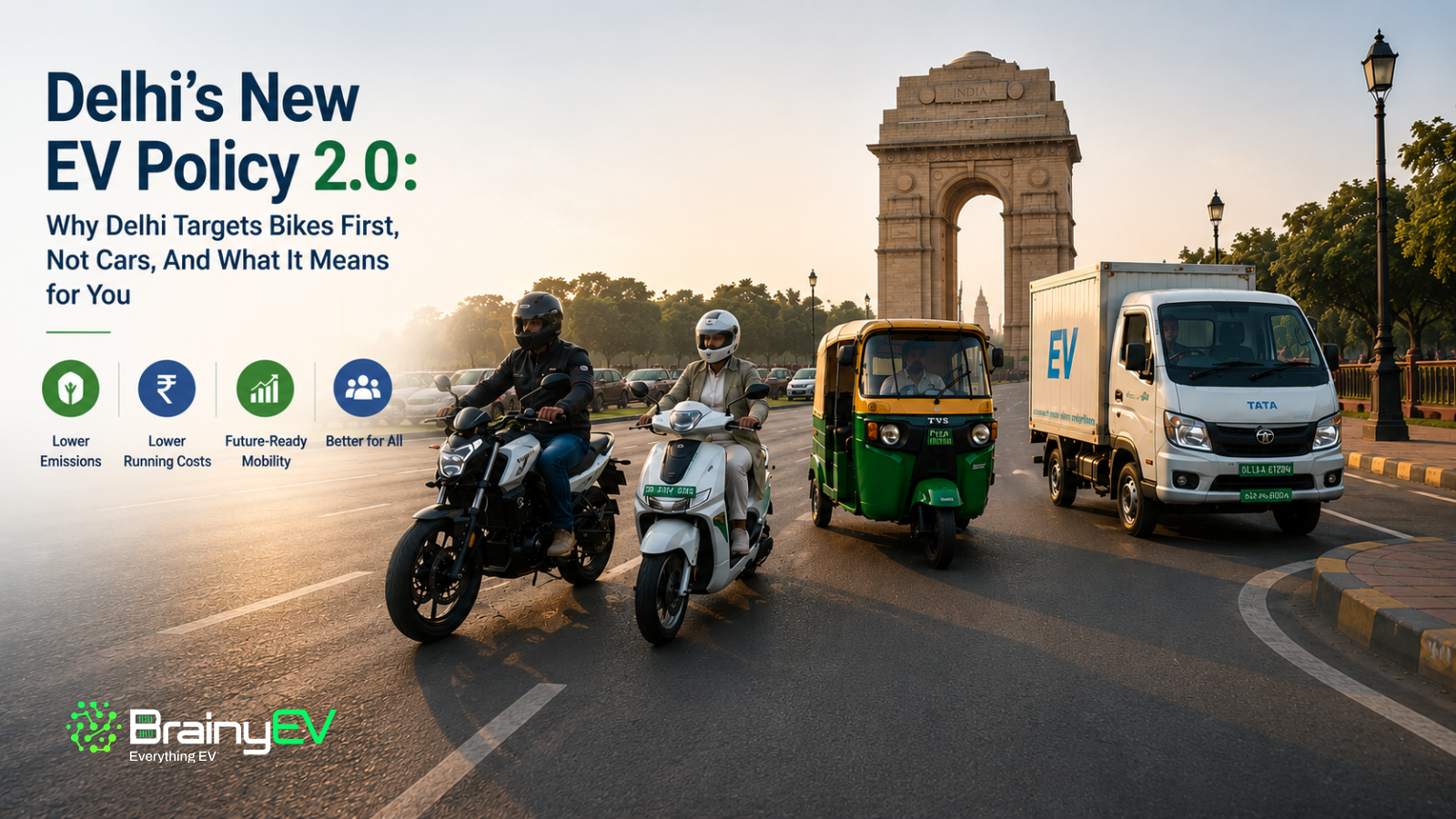
Delhi just made one of the boldest moves in India’s EV history. On June 29, 2026, the Delhi Cabinet approved a new Delhi EV Policy 2.0 with a ₹7,000‑crore budget, and a total projected investment of ₹15,000 crore, effective from July 1, 2026 and running till March 31, 2030.
But here’s the twist: Instead of starting with EV cars or big electric SUVs, the policy zeroes in on two‑wheelers and three‑wheelers. From April 1, 2028, only electric two‑wheelers will be allowed to be registered in Delhi.
Why? Because in Delhi, bikes and scooters are not just “common vehicles”, they are the main story of pollution, ownership, and daily mobility. If you commute, run a delivery business, or are thinking about buying an EV vehicle, this policy is directly relevant to you.
Let’s break it down.
The Big Picture: Delhi’s EV Policy in Numbers
Delhi just made one of the boldest moves in India’s EV history. On June 29, 2026, the Delhi Cabinet approved its Electric Vehicle Policy 2.0, with a ₹15,000‑crore budget, effective from July 1, 2026 and running till March 31, 2030.
From January 1, 2027, only EV three‑wheelers and N1 electric trucks can be registered in Delhi. From April 1, 2028, only EV two‑wheelers can be registered due to the upcoming banning two‑wheeler registrations decision.
On the incentive side, EV cars under ₹30 lakh get a 100% road tax and registration fee waiver. For EV two‑wheelers, customers can get up to ₹30,000 in year 1, ₹20,000 in year 2, and ₹10,000 in year 3. EV three‑wheelers can get up to ₹50,000 per vehicle, and N1 trucks up to ₹1 lakh per vehicle.
There are also scrapping incentives. You can get up to ₹1 lakh for BS‑IV four‑wheelers switching to EVs, ₹10,000 for two‑wheelers, ₹25,000 for three‑wheelers, and ₹50,000 for N1 trucks.
For charging, the policy aims for 32,000 public charging points over four years, supported by PM e‑Drive and state funding.
This is not a gentle nudge. It’s a timeline‑driven transition for key vehicle categories under the Delhi EV Policy 2.0.
Why Two‑Wheelers First? The Pollution + Volume Logic
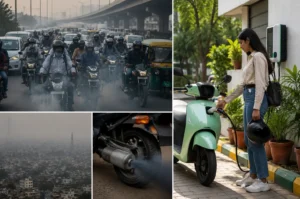
The India Today analysis gives a clear narrative: Two‑wheelers are Delhi’s biggest pollution problem by volume, not by size.
The numbers backing this are striking. Around 67% of Delhi’s vehicle stock is two‑wheelers, which means roughly two out of every three vehicles on Delhi’s roads are motorcycles or scooters.
Vehicular emissions contribute around 23% of Delhi’s PM2.5 in winter, making transport the single largest source of pollution in the city. Older studies from IIT Kanpur and TERI suggest that two‑wheelers alone account for about 31-33% of vehicular PM2.5 and more than half of CO emissions in the NCR.
Transport Commissioner Niharika Rai also cited that two‑ and three‑wheelers together contribute 46% of vehicular pollution, while commercial goods vehicles account for 33%.
So the logic is simple. If you want to reduce pollution quickly, you must start where the largest number of polluting vehicles exist. That’s two‑wheelers, not cars.
Through banning two‑wheeler registrations for petrol models from April 1, 2028, Delhi is trying to shift the entire personal commuter segment to electric in less than two years from now.
For you as a commuter, this means that if you currently own a petrol bike or scooter and plan to buy a new one after April 2028, it will have to be an EV two‑wheeler. If you buy now, you can get up to ₹60,000 in purchase incentives over three years, plus potential scrapping benefits if you retire an old vehicle.
Why Not Cars First? The Infrastructure Reality
You might wonder: cars occupy more road space, use more fuel, and dominate EV conversations. Why not start with EV cars?
The answer is infrastructure.
- EV cars usually:
- Run longer distances.
- Need larger batteries.
- Take more time to charge.
- Often depend on public charging stations.
- Two‑wheelers:
- Typically do short daily commutes.
- Have smaller batteries.
- Can often be charged at home on a normal socket.
- Can use battery‑swapping more easily and cheaply.
Delhi can’t wait for a full‑city, car‑grade charging ecosystem before starting the transition. But it can start with two‑wheelers, where home charging is already practical, battery swapping for last‑mile delivery and quick‑commerce is scaling, and the shift can happen without 100% charging coverage first.
At the same time, the Delhi EV Policy 2.0 plans 32,000 public charging points over four years, so charging infrastructure will grow alongside adoption.
If you’re unsure whether an EV two‑wheeler, EV three‑wheeler, or EV car fits your budget and commute under this new policy, compare real ownership costs on Brainy EV
Two Critical Narratives: Is This Policy Actually the Right Move?
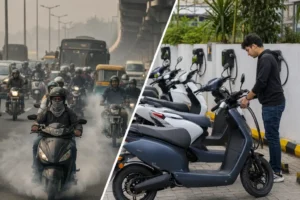
Let’s pause and think critically. The Delhi EV Policy 2.0 has a strong narrative around banning two‑wheeler registrations, but it also has risks. Here are two key perspectives.
Narrative 1: “Pollution‑First Logic” – Yes, This Is Correct
This view says: banning petrol two‑wheelers first is the right priority.
The main argument is that volume matters more than size. With 67% of vehicles being two‑wheelers, their total emissions are huge, even if each bike pollutes less than a car. Reducing two‑wheeler emissions gives quick, visible drops in PM2.5 and CO.
Another point is that the transition is affordable for most users. Average two‑wheeler buyers are students, young professionals, and daily commuters. Incentives of up to ₹60,000 plus scrapping support make EV two‑wheelers financially attractive.
There is also alignment with current usage patterns. Most two‑wheelers are used for short urban trips of 5–20 km, which suit EV range perfectly. This means there is no need for long‑distance charging infrastructure to start.
From this angle, the policy is strategically correct:
It tackles the biggest polluting segment by volume, without waiting for a perfect charging ecosystem.
Narrative 2: “Infrastructure‑First Logic” – Mandates May Be Too Early
This view says: Mandates like banning two‑wheeler registrations should come after infrastructure is ready, not before.
Experts have repeatedly flagged Delhi’s shortage of charging stations and battery‑swapping points. Many two‑wheeler users, especially in dense areas, may not have safe home charging or access to public chargers.
There is also a risk of forced buys under pressure. If petrol two‑wheelers disappear from April 2028 but charging is patchy, people may buy EVs out of necessity rather than preference, and face inconvenience, longer charging times, or reliability issues.
The rapid shift also creates supply chain and pricing pressure. Moving from about 7.5% EV share to 100% in under two years could stress OEM production, push prices up if demand outpaces supply, and create waiting periods or limited model choices.
From this perspective, the policy is too aggressive on timelines and risks shifting the burden to commuters instead of building infrastructure first.
Hybrid vs Pure EV: Why Delhi Dropped Hybrids
Earlier drafts of the policy considered road tax and registration waivers for strong hybrids up to ₹30 lakh. That idea has now been completely dropped.
Delhi is now backing only pure battery electric vehicles, not hybrids. Why?
- Hybrids still burn petrol, so they don’t deliver zero emissions. Delhi wants to accelerate directly to zero emissions vehicles, not treat hybrids as a long‑term bridge.
- The city wants to accelerate directly to zero‑emission vehicles, not treat hybrids as a long‑term bridge.
- Pure EVs align better with the 30% fleet electrification target by 2030.
- A clear signal: If you want the maximum policy benefit and align with Delhi’s zero emissions goal, go pure EV, not hybrid.
For buyers of EV cars under ₹30 lakh, this means:
- Full road tax + registration fee waiver.
- No hybrid equivalent benefit.
- A clear signal: If you want the maximum policy benefit, go pure EV, not hybrid.
What This Means for Different Types of Users
Let’s make this practical.
-
Daily Commuters (Two‑Wheeler Users)
If you plan to buy a new two‑wheeler before April 2028, you can still choose petrol. But if you buy after April 2028, it must be an EV two‑wheeler. You can get up to ₹30,000 + ₹20,000 + ₹10,000 incentives over three years, and a possible scrapping incentive if you retire an old bike or scooter.
-
Auto / E‑Rickshaw Drivers
From January 1, 2027, only EV three‑wheelers can be registered. You get up to ₹50,000 purchase incentive. Battery swapping and home charging are already growing in Delhi for this segment.
-
Small Logistics & Delivery (N1 Trucks)
From January 1, 2027, only EV N1 trucks can be registered. You get up to ₹1 lakh purchase incentive, and lower operating cost per km for EV vehicles compared to diesel.
-
Families Considering an EV Car
EV cars under ₹30 lakh get 100% road tax and registration fee waiver. There is no hybrid benefit, only pure EV gets this. If you have an old BS‑IV car, you may get a ₹1 lakh scrapping incentive when switching to an EV.
If you want a clear, no‑jargon breakdown of which EV car, EV two‑wheeler, or EV vehicle suits your needs under Delhi’s new policy, start your personalized check on Brainy EV
Why This Could Influence EV Cars and EV Vehicles Across India
Delhi often acts as a policy testbed for the rest of India. If this two‑wheeler‑first, mandated‑driven model under the Delhi EV Policy 2.0 works, other states may adopt similar rules for EV two‑wheelers, EV three‑wheelers, and small trucks. OEMs may prioritize EV vehicles for Delhi and other big cities, improving availability and pricing. Charging standards and public policies may align, making long‑distance EV car travel smoother.
Even if you’re not in Delhi, this policy signals where India’s EV cars and EV vehicles are heading in the next 3-5 years.
Your Window to Act Smart, Not Just Early
Delhi’s new “Delhi EV Policy 2.0” is not just about ‘clean air’ as a slogan. It’s about changing the cost structure and options for owning and running vehicles.
- For EV two‑wheelers: big incentives + future mandate.
- For EV three‑wheelers and N1 trucks: earlier deadlines + strong purchase support.
- For EV cars under ₹30 lakh: up to ₹1-3 lakh saved in up‑front costs.
- For people with old BS‑IV cars: scrapping + EV switch benefits.
If you’re thinking about an EV vehicle, now is a strong moment to check your current vehicle’s emission standard, calculate your total benefit from subsidy, scrapping, and tax waiver, and compare EV cars, EV two‑wheelers, and EV vehicles that fit your budget and usage.
Don’t let this policy window slip. Get a clear, personalized EV recommendation and cost breakdown tailored to your needs on Brainy EV