While there is a lot of noise about the negative impact of the EVs on the environment, the EV environmental benefits are clear once you understand the full picture.
Over the total carbon emissions lifecycle of an electric vehicle (production, operation, and disposal), EVs create significantly less carbon, noise, and air pollution than comparable petrol and diesel cars. They produce emissions at different stages, such as during manufacturing (especially the battery), during charging (depending on your electricity source), and at end of life through recycling.
When powered by renewable energy, the benefits of electric vehicles on the environment grow even stronger.
Environmental Impact of EVs: Key Numbers at a Glance
70 – 78% lower lifecycle emissions for Battery Electric Vehicles (BEVs) than petrol cars, on average electricity mixes.
1 – 2 years – Typical time for an EV to pay off its manufacturing “carbon debt” through cleaner driving.
Zero tailpipe emissions from BEVs & PHEVs match this only in electric mode.
EVs are not zero-impact on the environment. But across the full lifecycle production, operation, and disposal. They create meaningfully less carbon, noise, and air pollution than comparable petrol and diesel cars.
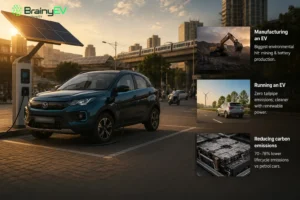
EV’s Sustainability Is Driven by Lower EV Lifecycle Emissions and Zero Tailpipe Emission
Manufacturing an EV
The first big environmental hit happens in the factory. EV batteries use minerals like lithium, cobalt, manganese, nickel, and graphite. Extracting and processing these for EV battery mining is energy-heavy and can cause local water and ecosystem issues.
This makes manufacturing a new EV even more emission-intensive than a regular car, mainly due to the large battery packs. However, the total EV lifecycle emissions over the vehicle’s life are still much lower than petrol or diesel equivalents. Some batteries, like LFP(Lithium Iron Phosphate), avoid cobalt and nickel entirely.
Running an EV
Your day-to-day environmental impact depends on what kind of EV you drive.
BEVs (Battery Electric Vehicles): No tailpipe emissions at all, in any mode.
PHEVs (Plug-in Hybrids): Run clean in electric mode, but switch to the petrol engine based on convenience.
EVs also produce some pollution from tyres and road wear, just like regular cars.
Electric vehicle sustainability improves dramatically when you charge them with renewable sources like solar or wind.
Reducing carbon emissions
Transport is a major emitter worldwide. Shifting to electric vehicles offers some practical ways to cut these numbers. Studies show that BEVs have 70-78% lower lifecycle emissions than gasoline cars on average electricity mixes. The “carbon debt” from production is usually paid off within the first 1-2 years of driving.
Cleaner grids make the advantage bigger every year.
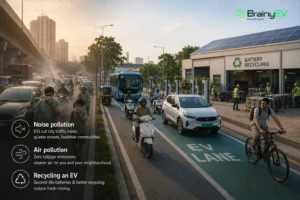
The Benefits of Electric Vehicles on the Environment Include Lower Noise Pollution, Cleaner Air, and and Expansive EV Recycling Ecosystem
Noise pollution
Road traffic is a major source of unwanted noise that affects health and wildlife. EVs are much quieter at city speeds. More EVs on the road means measurably less noise pollution overall.
Air pollution
Petrol and diesel cars pump out pollutants linked to breathing problems and premature deaths. BEVs produce zero tailpipe pollution, and PHEVs avoid it in electric mode. This directly helps you and your community breathe much cleaner air.
Recycling an EV
The growing EV industry is pushing better EV recycling ecosystem practices. While global battery recycling rates are still low, second-life uses (like home energy storage) and new recycling tech are expanding. This reduces the need for fresh mining and supports circular economy goals.
The Bottom Line
EVs are not zero-impact. EV battery mining has real costs, but across the full lifecycle, they deliver more clear EV environmental benefits over traditional cars. The gap widens as electricity gets cleaner and recycling improves.
Ready to understand how an EV would actually perform for your driving needs?
Explore EV options and real-world impact at Brainy EV
Make smarter choices for your wallet and the planet. Visit Brainy EV today.
FAQs
- Are EVs really better for the environment?
Yes. While battery production creates higher upfront emissions, EVs have 70-78% lower total EV lifecycle emissions than petrol cars over their lifetime.
- How long does it take for an EV to offset its production emissions?
Most EVs recover their “carbon debt” within 1 to 2 years of normal driving.
- Does the electricity source matter?
Absolutely. Charging with coal-heavy power reduces the benefit. Renewable energy (solar, wind) makes the benefits of electric vehicles on the environment much stronger.
- What about EV battery mining and recycling?
Although EV battery mining has certain environmental costs, the EV recycling ecosystem is evolving rapidly through the reuse of materials, which helps mitigate future impact.
- Are EVs worth it for the average driver?
For most people, yes, lower running costs, cleaner air, and strong EV environmental benefits help make them a smarter long-term choice.
Related Reads
EV Carbon Footprint by Indian State: Why Location Changes the Climate Impact