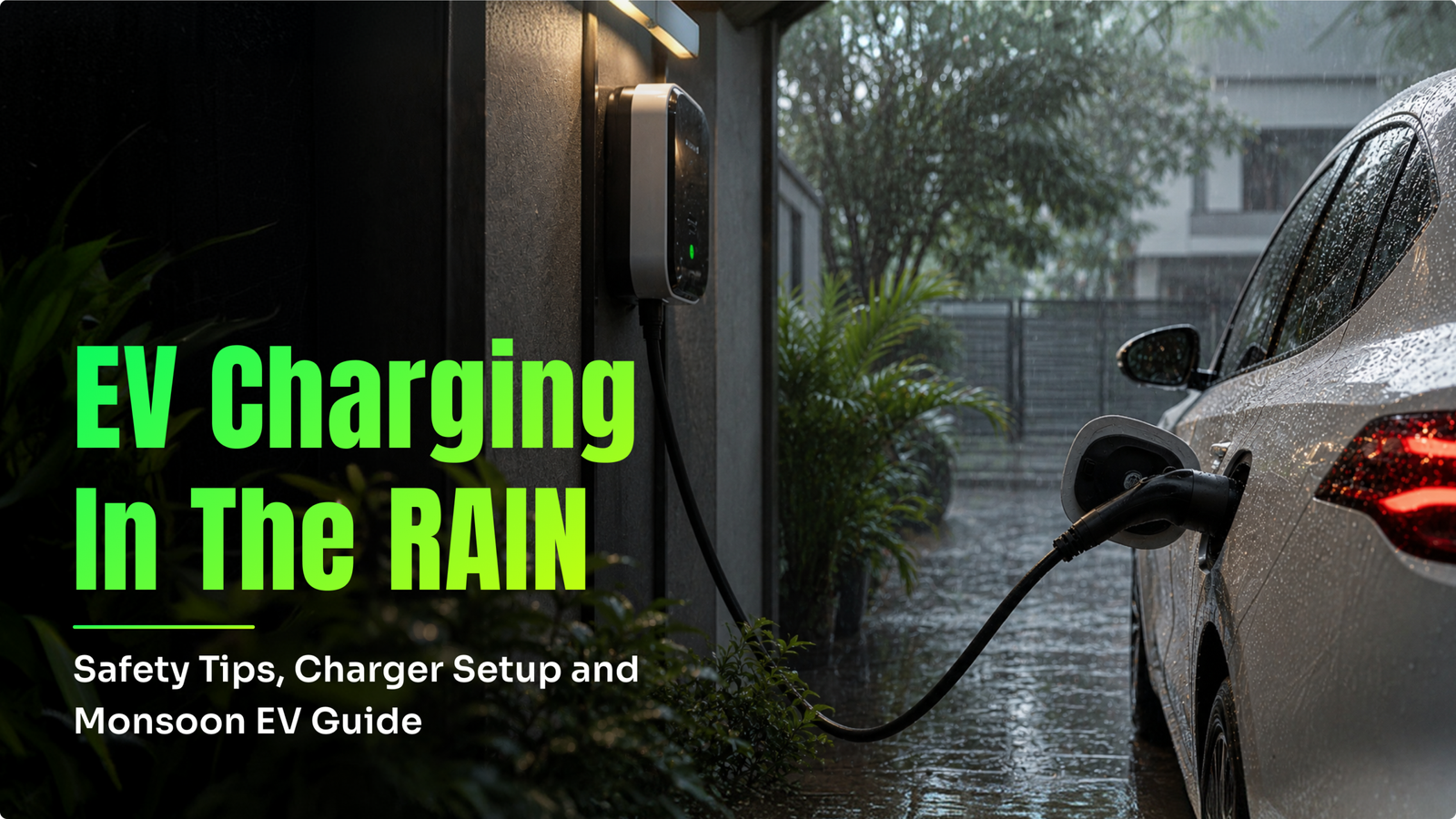
Let’s tackle the question most Indian EV owners ask during the rainy season: Is it actually safe to charge my electric vehicle in the rain?
You’ve probably grown up hearing warnings about mixing electricity and water, a fork in the toaster, a hair dryer near the bathtub. So the hesitation is natural. But when it comes to EVs specifically, the answer is reassuring: EV charging in rain is safe, provided you use the right equipment and follow a few sensible practices.
EV Charging in Rain: Safety Provisions and Standards
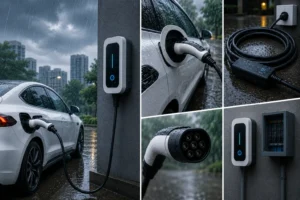
When we talk about EVs in particular, EVs can safely be charged in all kinds of weather. Automakers and charging-equipment manufacturers have done extensive tests to prove it is safe.
-
Built-in Safety Provisions for Outdoor Charging
Charging technology must meet specific ratings and standards from organizations like the International Electrotechnical Commission (IEC) and SAE International. These standards cover protection against moisture, dust, and sand. Insulation levels. Resistance to temperature rises
These rules apply both when the charger is connected to the vehicle and when it is disconnected.
-
Why a Plugged-In Cord Is Not a Shock Hazard
One common fear is dropping a plugged-in cord in a puddle and shocking someone with the circuit’s full power. With the EV charging equipment, the cord is fully energized only after it has been connected to the car and an electronic handshake between the vehicle and charger confirms that it is safe to begin charging.
According to industry standards, the voltage between any two pins on the charging connector must remain below 60V whenever the equipment is disconnected. This drastically reduces the risk of shock even if the cord falls into the water.
When the vehicle is plugged in, the cord and charging port form a connection that’s rated IP44. This standard means it is sealed against splashed water. However, it is not fully watertight. A mated plug may still allow water in if it is directly sprayed with a pressure washer or if the vehicle is submerged in floodwaters. In such extreme cases, engineers rely on electrical safeguards to protect people and equipment from short circuits.
-
Ground Pins and Internal Protection Systems
Like the three-prong power cords used on TVs, refrigerators, and microwaves, EV charging cords are designed so that the ground pin is the first to make contact when you plug in the car and the last to break contact when you unplug it. This ground pin establishes a path of least resistance so that electricity harmlessly discharges into the earth rather than someone standing nearby in the event of a short circuit.
The charging equipment and vehicle also include internal protection systems that immediately cut power and disable charging when a short is detected. Multiple layers of safety make it safe to charge an electric car in the rain.
-
When You Need to Take Extra Caution
There are some situations where extra caution is needed:
- Portable cords: You must use a portable cord to charge an EV instead of a conventional home or public charging station. Ensure both the cord and the outlet are in good shape and designed for outdoor use.
- Outdoor 240V equipment: If you plan to install 240V EV charging equipment outdoors, ensure the unit you buy is approved for outside use. Some charging devices are for indoor/garage use only, while the cord and connector can safely be used in the rain, the wall-mounted box containing the electronics may not be sealed against the elements.
- Proper installation: Make sure any EV charging equipment you use at home is installed properly. This is a job best left to a licensed electrician.
All these points ensure that it is safe to charge an electric car in the rain, as long as you use the right equipment and follow basic safety practices.
EV Charging in Rain: Safe Practices for EV Owners
Charging an EV during monsoon needs extra care. While modern EV chargers and ports are weather-resistant, water and electricity together can still be dangerous if handled improperly.
Is It Safe to Charge Your EV in the Rain?
Yes, EV charging in rain is safe if you use certified, waterproof chargers and follow basic precautions. EV chargers are built with:
- Waterproof enclosures (IP65 or higher)
- Auto power cut-off features
- Ground fault protection systems
- Shock-proof cables and connectors
If any fault is detected, power flow is automatically interrupted. So with proper equipment and practices, you don’t need to stop charging during the monsoon.
Smart Charging Habits for Monsoon
- Always charge your EV in a dry, covered area away from rain.
- If you have ridden through wet conditions, let the EV dry completely before plugging it in.
- Use only manufacturer-recommended or certified chargers.
- Avoid charging in waterlogged or flooded areas.
- Keep your charging cable dry and clean; store the charging gun in its holster when not in use.
- Install home chargers under a canopy or shelter.
- Do not attempt DIY repairs or makeshift setups.
These habits protect both your EV and your charging station, and reduce the risk of short circuits or damage.
Making Your Charging Station Monsoon-Ready
Your home EV charger is an electrical appliance and is vulnerable to the elements. Heavy rain, high humidity, and power fluctuations during monsoon can lead to short circuits, corrosion, or complete failure.
-
Check the IP Rating
Know your charger’s IP (Ingress Protection) rating. For outdoor installation, aim for at least IP54, for areas with very heavy rainfall, IP65 or higher is ideal.
-
Install Under Shelter and Use Enclosures
Install your charger under a covered porch, carport, or canopy. If a permanent shelter isn’t possible, use a waterproof enclosure designed for ventilation.
-
Inspect Wiring, Install Surge Protectors, and Ensure Grounding
Before the monsoon, have a qualified electrician inspect wiring, junction boxes, and connections. Install a dedicated surge protector for your EV charger. Ensuring proper grounding, like a strong earthing system which is vital during lightning storms.
These practices protect your charging station and ensure safe EV charging in rain for the entire season.
Driving an Electric Vehicle in the Rain
Wet roads reduce traction and increase braking distance. When driving an electric vehicle in the rain, adjusting your habits is crucial.
-
Tyres, Brakes, and Stability
Check tyre tread depth and maintain correct tyre pressure. Ensure brakes are in good condition. Use safety features like ABS, traction control, and stability control if available.
-
Acceleration and Braking
Accelerate smoothly to avoid sudden bursts of power. Brake gradually to maintain the control. Make sure to keep a safe distance from the other vehicles.
These habits improve safety and efficiency, especially for daily-use EV cars and EV scooters.
Choosing EVs Built for Indian Weather: A Key Part of EV Maintenance in Monsoon
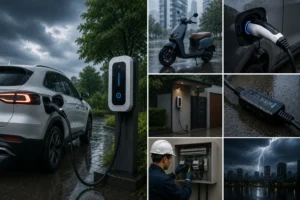
Indian monsoons can be pretty harsh, especially for vehicles that operate for long hours. EVs are designed and tested for Indian roads and climate conditions, which offer better durability.
When buying an EV car in India, look for:
- High IP ratings for battery and motor
- Proven performance in monsoon conditions
- Strong after-sales support
- Features like traction control and stability systems
Selecting the right EV reduces the risk of monsoon-related issues and gives you more confidence on wet roads.
Common Mistakes to Avoid During EV Monsoon Care
Many problems come from simple mistakes, such as, charging in waterlogged areas or during lightning storms, ignoring visible damage to cables, connectors, or battery seals, using non-certified or makeshift chargers, skipping regular servicing and battery health checks or driving through deep water without checking depth or route
Avoiding these mistakes is a key to proper EV maintenance monsoon and a longer battery life.
Rain Checklist for EV Monsoon Care
A little proactive effort can save you a lot of hassle, cost, and risk for later.
If you want to check out the complete Electric Vehicle monsoon guide with step-by-step EV Monsoon Care, electric vehicle rain protection, EV charging in rain tips, and EV battery monsoon precautions, then click here to get expert guidance from Brainy EV:
Get The EV Monsoon Guide Now
FAQs
1. Do EV chargers automatically shut off if water gets in?
Yes. EV charging equipment includes internal protection systems that continuously monitor for faults. If moisture triggers a short circuit or irregularity, the system cuts power immediately, before it becomes a safety hazard.
2. What happens if a plugged-in EV charging cord falls into a puddle?
The risk is much lower than people assume. The cord is only fully energized after the vehicle and charger complete an electronic handshake confirming it’s safe to charge. When disconnected, voltage between the connector pins stays below 60V, significantly reducing shock risk even if it lands in water.
3. What IP rating should my home EV charger have?
For outdoor installation, aim for at least IP54. If you live in an area with very heavy rainfall, IP65 or higher offers better protection against water and dust.
4. Can I install my EV charger outdoors without any shelter?
It’s not recommended. Even weather-resistant chargers benefit from a covered porch, carport, or canopy. If a permanent shelter isn’t possible, use a ventilated, waterproof enclosure instead of leaving the unit fully exposed.
5. Do I need a licensed electrician to install my home EV charger?
Yes. Proper installation, along with wiring inspection, surge protection, and solid grounding, should always be handled by a qualified electrician, especially since these safeguards matter most during monsoon storms and lightning.