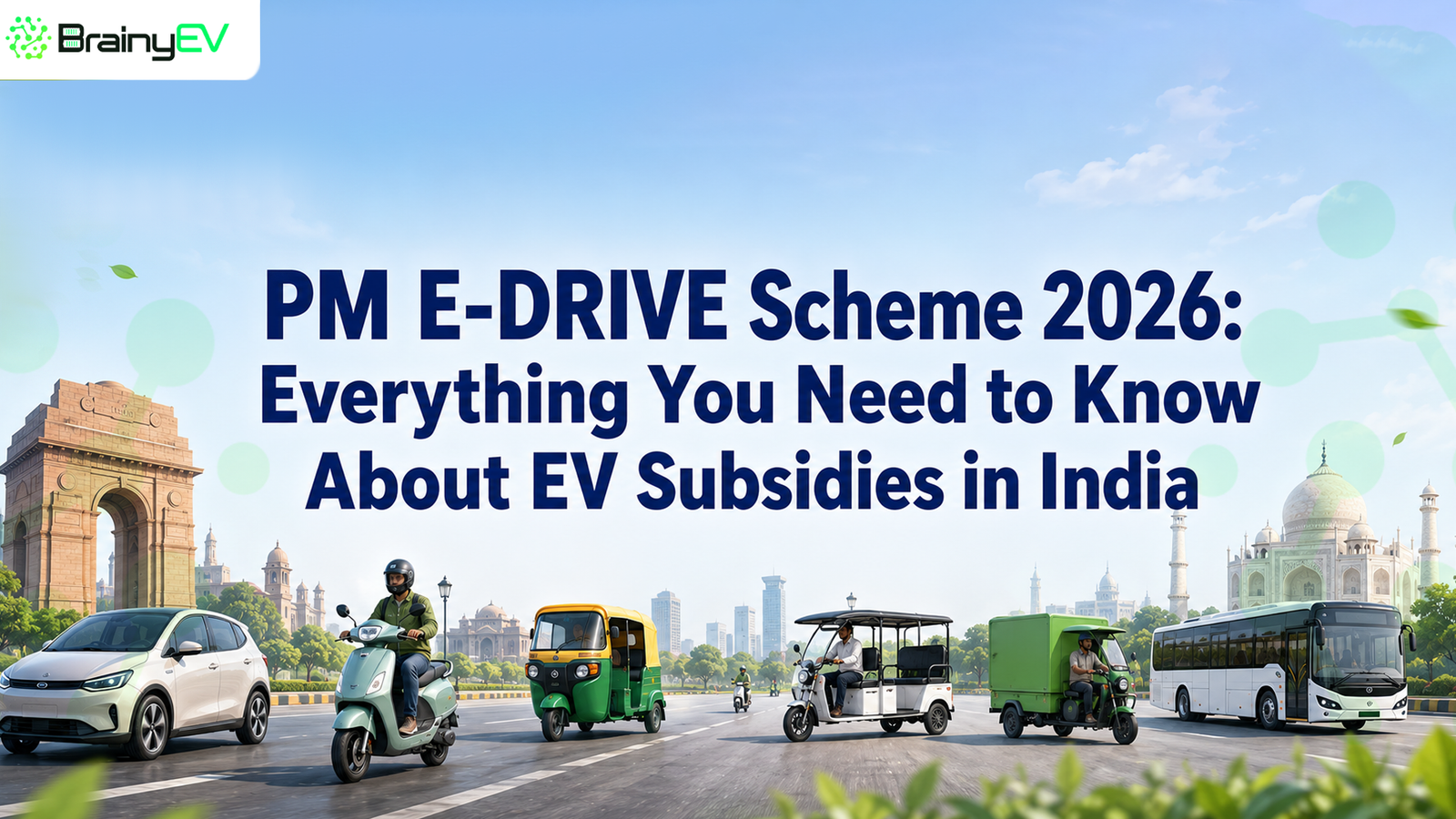
The electric vehicle revolution in India is no longer a thing of the future. It is unfolding right now on our streets. If you have been planning to switch to an electric scooter or a commercial three-wheeler or are simply curious about how the government is backing green mobility, you’ve likely heard about the PM E-DRIVE Scheme 2026.
Administered by the Ministry of Heavy Industries EV scheme framework, this ₹10,900 crore initiative replaced the older FAME-II program to make clean energy affordable for everyone. Following critical policy revisions, including a dedicated allocation for advanced battery technology and fresh extensions. Navigating these latest EV incentives in India 2026 is essential before you make your purchase.
Let’s break down exactly how this government electric vehicle policy of 2026 works, who is eligible, and how you can save money.
What is the PM E-DRIVE Scheme?
PM E-DRIVE stands for PM Electric Drive Revolution in Innovative Vehicle Enhancement, and it puts money directly in the buyer’s pocket. Instead of giving tax breaks to manufacturing companies, the Government of India uses this scheme to offer massive, direct demand incentives, upfront discounts, to everyday buyers. When you buy an eligible vehicle, the dealer cuts the price at the counter, and the government later reimburses the manufacturer.
This is a fundamental shift from how subsidies used to work. No paperwork after purchase. No waiting for reimbursements. The discount happens at the point of sale, instantly.
PM E-DRIVE vs FAME II: Key Differences
The transition from FAME II to PM E-DRIVE is not just a name change, it is a structural overhaul of how India funds electric mobility.
| Parameter | FAME II | PM E-DRIVE 2026 |
| Total Budget | ₹11,500 Crore (closed) | ₹10,900 Crore (active) |
| Private Cars (E-4W) | Included & incentivised | Explicitly excluded |
| New Vehicle Categories | None | E-Ambulances (₹500 Cr), E-Trucks (₹500 Cr) |
| Subsidy Claim Process | Post-purchase OEM claims | Instant Aadhaar-authenticated E-Voucher at dealership |
| Charging Infrastructure | General, slower rollout | Dedicated ₹2,000 Crore for 72,300 fast chargers |
| Focus | Early adoption across all segments | Mass transit & localised component supply chains |
How Much Money Can You Actually Save?
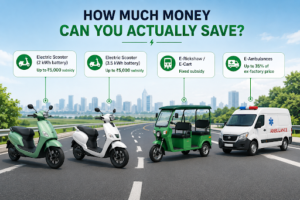
The subsidy is tied directly to your vehicle’s battery capacity, here’s the exact maths for your wallet.
Under the PM E-DRIVE benefits structure, the upfront demand incentive is calculated at ₹2,500 per kWh of battery capacity, capped at ₹5,000 per vehicle for two-wheelers. Here is how that plays out:
- Electric Scooter with 2 kWh battery: 2 × ₹2,500 = ₹5,000 total subsidy
- Electric Scooter with 3.5 kWh battery: 3.5 × ₹2,500 = ₹8,750, but capped at the maximum of ₹5,000
- E-Rickshaw / E-Cart: Fixed framework allocation that varies by certified model, with ex-factory price capped at ₹2.5 lakh
- E-Ambulances: Up to 35% of the vehicle’s ex-factory price covered under a brand-new ₹500 crore allocation
Not sure which electric scooter gives you the best value after the PM E-DRIVE subsidy? BrainyEV breaks down the numbers across all major models.
Explore EV comparisons on BrainyEV
Eligible Vehicles & Subsidy Caps
The government has set strict price caps to keep the focus on mass mobility, luxury vehicles are excluded by design.
| Vehicle Segment | Units Targeted | Subsidy / Cap Structure |
| Electric 2-Wheelers (e-2W) | 24.79 Lakh units | ₹2,500 per kWh, capped at ₹5,000 max. Ex-factory price must be under ₹1.5 lakh. |
| E-Rickshaws & E-Carts | 3.2 Lakh units | Strict ex-factory price cap of ₹2.5 lakh to claim subsidy. Commercial use only. |
| E-Buses | 14,028 buses | ₹4,391 crore allocation. Procured by State Transport Undertakings and public agencies across 9 major cities, not applicable to individual buyers. |
| E-Trucks | 5,643 trucks | ₹500 crore allocation. Requires a valid scrapping certificate for an older diesel cargo truck. |
| E-Ambulances | 3,811 units | Brand-new ₹500 crore allocation. Covers up to 35% of the vehicle’s ex-factory price. |
The Battery Rule: Subsidies for e-rickshaws and two-wheelers are only applicable if the vehicle uses advanced battery technology, such as certified Lithium-ion. Old-school lead-acid batteries do not qualify.
Best Electric Scooters Eligible for PM E-DRIVE in 2026
The rule is simple: ex-factory price under ₹1.5 lakh with a certified advanced battery setup.
The most popular electric scooters in India currently certified for the PM E-DRIVE subsidy includes:
- Ola Electric:Ola S1 X (all battery variants)
- Ather Energy:Ather Rizta (family focus) and Ather 450X / 450S
- TVS Motor:TVS iQube (Standard and S variants)
- Bajaj Auto:Bajaj Chetak
- Hero MotoCorp:Hero Vida V1 / V2
Always confirm eligibility at the authorised dealership before purchase, as model-level certification can change with price revisions.
Step-by-Step: How to Get PM E-DRIVE Subsidy (The E-Voucher Process)
The process to apply for the EV subsidy online in 2026 has been completely digitised to avoid corruption and paperwork delays. Everything relies on a secure electric vehicle e-voucher generated at the time of purchase.
Here is how the workflow functions when you buy your EV:
- Select an Eligible EV: At the Dealership.
Visit an authorised showroom and choose a model from the official list of eligible EVs under the PM E-DRIVE scheme. Ensure the vehicle fits within the ex-factory price limits.
- Aadhaar-Based Authentication: Identity Verification.
The dealer will initiate an Aadhaar-based e-KYC process. This ensures that the vehicle incentive is mapped securely to a unique identity and prevents duplicate subsidy claims.
- E-Voucher Generation: Instant Mobile Delivery.
A digital electric vehicle e-voucher download link is generated via the unified Ministry platform and sent directly to your registered mobile number as an SMS or digital link.
- Sign and Secure the Discount: Final Step.
You and the dealer digitally sign the e-voucher dynamically. The discount is instantly slashed from your bill, and the dealer submits the voucher back to the portal for their reimbursement.
Beyond Vehicles: EV Charging Infrastructure Support India
One of the massive benefits of PM E-DRIVE for small businesses and the public is the ₹2,000 crore deployment for EV charging infrastructure to support India. The government recognises that people will only buy EVs if they can charge them reliably.
This fund is actively being used to install:
- Public charging stations across 9 major high-penetration metros.
- Fast-charging corridors along major national highways to eliminate “range anxiety” during long road trips.
Who Should Buy an EV in 2026?
The PM E-DRIVE scheme framework alters the value proposition depending on how you use your vehicle.
Highly Beneficial For:
- Daily Commuters & Students: Anyone travelling 20–50 km a day will break even on the upfront cost within 18 months.
- Delivery Partners & Small Businesses: Exceptional running-cost efficiency directly increases daily profit margins.
- Fleet Operators: High vehicular utilisation translates to massive long-term fuel savings.
Not Ideal For:
- Inter-state Highway Travellers: If your primary usage involves long, cross-country highway runs, the current public charging density may still cause operational friction, despite highway corridor funding.
Whether you are an individual looking for an eco-friendly daily commute or a logistics operator registering for commercial EV subsidy registration, the PM E-DRIVE scheme makes 2026 the absolute prime time to switch to electric.
Keep an eye on the July 31, 2026, deadline. If you are buying a two-wheeler, make sure your dealer processes your Aadhaar-authenticated e-voucher at checkout, and enjoy the savings of zero-tailpipe-emission driving!
Before You Walk Into the Dealership: Your PM E-DRIVE Checklist
Five minutes of preparation before you visit the showroom can save you the subsidy and the frustration.
The most common reason buyers miss out on the PM E-DRIVE subsidy is not ineligibility, it is being unprepared at the dealership. The Aadhaar e-KYC process is fast and paperless, but only if your details are in order. Here is everything you need to confirm before you walk in:
Your PM E-DRIVE Pre-Purchase Checklist
1. Documents & Identity
Confirm your Aadhaar card is active and the mobile number linked to it is still in use and accessible
Verify your Aadhaar-registered mobile number at myaadhaar.uidai.gov.in if you are unsure which number is linked
Carry your Aadhaar card (physical or DigiLocker copy) to the dealership, this is the only document required
2.Vehicle Eligibility
Confirm the model you want is on the official PM E-DRIVE eligible list, ask the dealer to verify this specifically
Ensure the variant you choose has an ex-factory price under ₹1.5 lakh, adding premium software packs can push it over
Confirm the vehicle uses a certified Lithium-ion battery, lead-acid battery vehicles do not qualify
3. the Dealership
Ask the dealer to initiate the Aadhaar-based e-KYC process before finalising any billing, do not sign the invoice first
Ensure the e-voucher SMS arrives on your registered mobile before you sign the digital confirmation
Double-check that the subsidy amount has been deducted from your final invoice before payment, not promised as a post-purchase cashback
Confirm this is your first EV purchase, the subsidy is a one-time benefit per individual across India
4. Deadline & Timing
Electric two-wheelers (e-2W): must be registered on or before July 31, 2026. Booking alone does not count.
E-rickshaws and e-carts (e-3W): have a longer runway — registered on or before March 31, 2028.
Check your state RTO’s processing time, peak-month registrations can take longer, so avoid last-minute visits in late July
What PM E-DRIVE Means for India’s EV Future
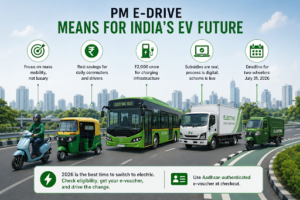
This is not just a subsidy scheme; it is a structural bet on where India’s mobility is heading.
The PM E-DRIVE scheme represents a deliberate, targeted policy choice. By directing the ₹10,900 crore budget away from private cars and towards two-wheelers, commercial three-wheelers, buses, and ambulances, the government is essentially saying: India’s EV transition will be built on mass mobility, not luxury adoption.
This matters because it directly addresses the segments where fuel cost savings are most meaningful, the daily commuter on a scooter, the e-rickshaw driver in a Tier-2 city, the BEST or DTC bus on an urban route. These are the users who spend the highest proportion of their income on fuel, and for whom an electric alternative changes the economics of daily life, not just the environmental footprint.
The ₹2,000 crore charging infrastructure commitment signals that the government is aware of the chicken-and-egg problem that plagued earlier EV adoption: people won’t buy EVs without chargers, and chargers won’t be installed without buyers. By funding infrastructure through the same scheme that funds vehicle subsidies, PM E-DRIVE attempts to solve both sides simultaneously.
For individual buyers in 2026, the practical message is straightforward. The scheme is live, the subsidies are real, the process is digitised, and the deadline for two-wheelers is concrete.
If you have been on the fence about switching to electric, this is the most financially favourable window India has offered so far.
Whether you are an individual looking for an eco-friendly daily commute or a logistics operator exploring commercial EV options, the PM E-DRIVE scheme makes 2026 the absolute prime time to switch to electric. Keep an eye on July 31, 2026, for two-wheelers and March 31, 2028, for e-rickshaws and e-carts. For two-wheelers, make sure your dealer processes your Aadhaar-authenticated e-voucher at checkout.
Stay updated on EV schemes, subsidies, and buying guides at BrainyEV
India’s most trusted resource for EV ownership, from policy to parking.