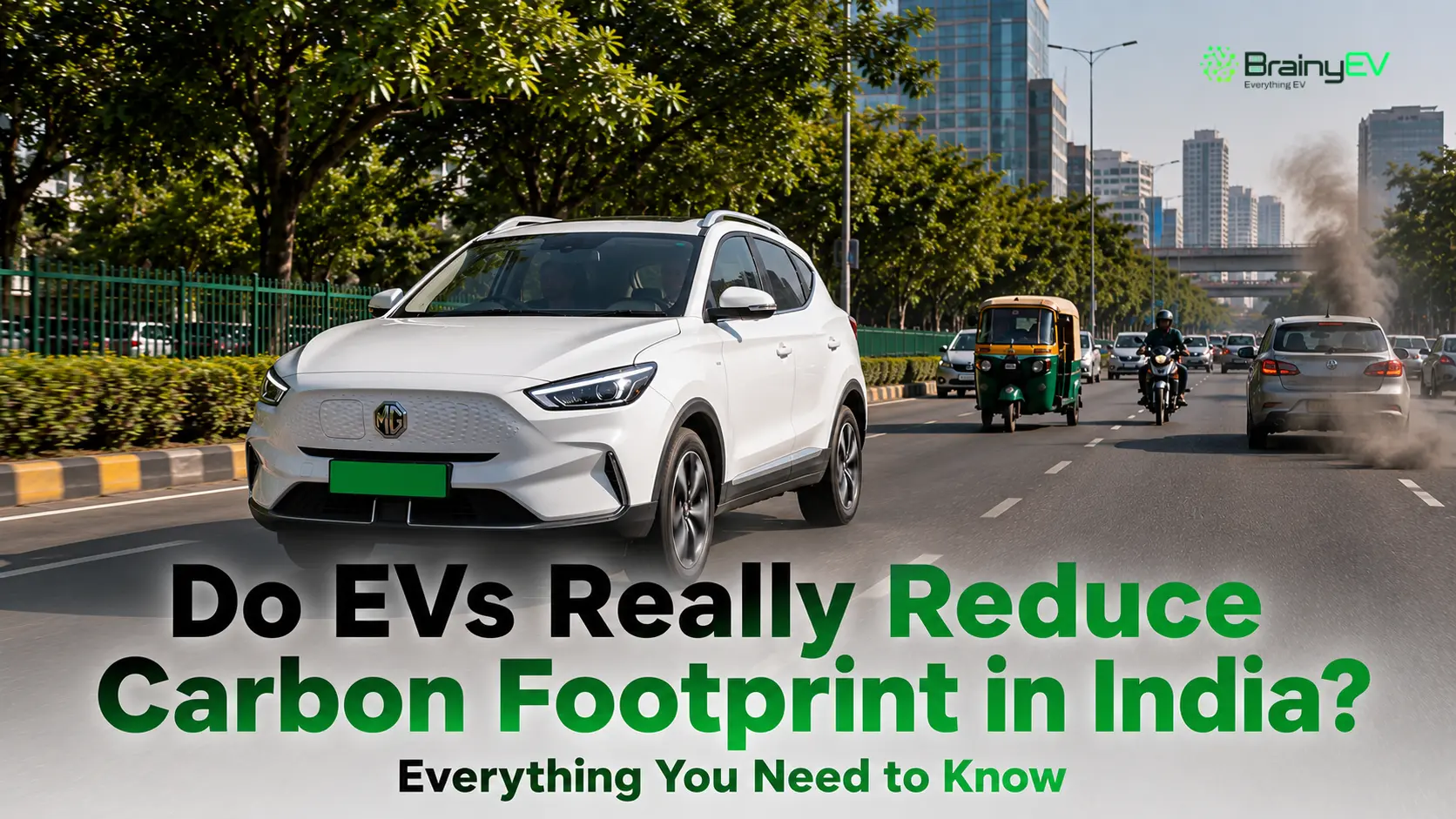
Electric vehicles can reduce EV lifecycle emission in India by up to 38% over 150,000 km. That benefit depends heavily on the grid’s coal share, charging timing, and how the batteries are made and recycled. EV carbon footprint in India is a hot topic as the country pushes hard for electric mobility. Electric vehicles promise cleaner air and lower pollution, but do they actually deliver lower electric vehicle carbon emissions in a coal-heavy country like India? Let’s break it down.
EV vs Petrol Carbon Emissions: The Lifecycle View
When you look at EV lifecycle emissions from manufacturing to end-of-life, battery electric vehicles (BEVs) in India still come out cleaner than petrol or diesel cars, but with a smaller margin than in countries with cleaner grids. Life-cycle assessments show BEVs in India can emit 14-38% less CO₂-equivalent per kilometre than internal combustion engine (ICE) vehicles, provided the grid continues to decarbonise, and charging is optimised.
The manufacturing phase of an EV can carry 35-40% higher greenhouse gas emissions than a comparable petrol or diesel car, largely due to battery production. Even this upfront carbon debt is repaid over time as the vehicle runs on electricity instead of fuel.
EV Charging Emissions and the Indian grid
India’s electricity grid is still dominated by coal (around 70-75% in recent years). This means EV charging emissions are higher than in countries with greener power. A significant portion of charging still relies on fossil fuels, which reduces the immediate climate benefit.
As renewable energy grows (solar and wind are expanding fast), EV vs petrol carbon emissions will tilt more clearly in favour of electric vehicles. Experts project that better grid decarbonisation could deliver 18-50% emission reductions by 2040.
Manufacturing, Minerals, and E-waste: The Hidden Costs
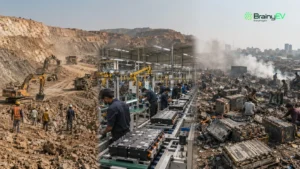
The Road to Cleaner Mobility: From Battery Manufacturing to Recycling
The EV carbon footprint in India isn’t just about tailpipe emissions. It includes:
- Mining and processing of lithium, nickel, and cobalt (largely imported today).
- Battery cell and pack manufacturing, often powered by fossil-fuel-heavy grids.
- End-of-life battery management and the risk of growing e-waste.
India currently recycles less than 5% of end-of-life lithium-ion batteries through authorised channels. The rest flows into informal sectors with weaker environmental safeguards. The NITI Aayog figure (6.19 MMT, 2024, growing 17%/year toward 14 MMT by 2030) of e-waste generated annually, including a fast-rising share of spent EV batteries, recycling capacity and reverse logistics are the urgent priorities.
The Break-even Point and Decarbonisation paths
Research shows EVs reach a “break-even” point, where their total lifecycle emissions drop below those of diesel or petrol cars, after a certain distance driven, typically within a few years of normal use. Beyond that, every kilometre adds to net emissions savings, especially as the grid gets cleaner.
Key levers to maximise climate benefits:
- Cleaner manufacturing: More renewable energy in cell/pack plants and OEM factories. Some two/three-wheeler makers already report 50–60% renewable energy use, with roadmaps to 100%.
- Smarter charging: Daytime charging, solar rooftops, and renewable-powered public stations can meaningfully lower the operational footprint.
- Circular batteries: Stronger recycling, second-life applications, and closed-loop supply chains can cut both carbon and resource risks.
Are EVs Really Greener in India? The Road Ahead
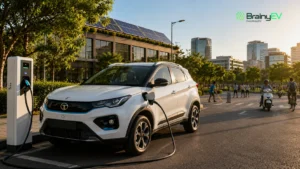
The Next Step to a Cleaner Grid, Renewable Energy and Stronger Sustainability
On average, EVs already show lower EV lifecycle emissions than petrol vehicles in India, especially in states with higher renewable energy. The advantage grows every year as the grid cleans up and recycling improves. For city commuting and two-wheelers, the benefits on local air quality are immediate and much clearer.
Government policies like FAME, state EV incentives, and Battery Waste Management Rules are helping. Faster adoption of renewables and local battery manufacturing will make EVs even greener. EVs reduce the carbon footprint compared to petrol vehicles, but India needs a cleaner grid and stronger recycling to unlock its full potential.
Make an informed switch. Visit Brainy EV today and discover which EV makes sense for your driving pattern and India’s current energy reality.
Related Reads:
EV Carbon Footprint by Indian State
FAQs
1.Do EVs really reduce carbon emissions in India?
Yes, EVs in India do reduce carbon emissions, producing up to 38% lower EV lifecycle emissions than petrol cars. While EV carbon footprint in India depends partly on the electricity source, EVs still offer significantly lower electric vehicle carbon emissions than conventional petrol vehicles.
2.Are EVs cleaner if India’s grid is mostly coal?
Yes, EVs are still cleaner. Despite India’s heavy reliance on coal, centralised power plants are far more efficient than millions of individual internal combustion engines (ICEs). Even after accounting for EV charging emissions, EVs waste less energy and produce zero tailpipe emissions, resulting in lower EV carbon emissions and improved local air quality.
3.What about emissions from making EV batteries?
Manufacturing EV batteries has a heavy carbon footprint, generating between 60 and 90 kg of CO₂ per kWh of battery capacity. However, these initial EV lifecycle emissions are offset within 1 to 2 years of driving because EVs produce zero tailpipe emissions, making their overall EV vs petrol carbon emissions significantly lower over time.
4.Won’t old EV batteries create e-waste problems?
Old EV batteries can pose e-waste and fire hazards if not handled properly. However, because these batteries retain high value, India is rapidly expanding specialised recycling and repurposing infrastructure to reduce the overall EV carbon footprint in India and prevent batteries from ending up in landfills.
5.Which cities in India get the biggest EV climate benefit?
Cities with the highest vehicular pollution and the fastest adoption of electric two-wheelers and buses see the greatest reduction in electric vehicle carbon emissions. This includes Delhi NCR, Bangalore, Mumbai, Pune, and Hyderabad, where the climate and public health benefits of lower EV vs petrol carbon emissions are most significant.