Every time petrol price rises in Delhi NCR, my WhatsApp groups light up with the same debate: is it finally time to switch to electric? Usually the conversation dies at “but EVs are expensive” and “resale is a headache.” Fair points, both. But if you live in Haryana and you’ve been putting off that EV decision, the math just changed in a big way.
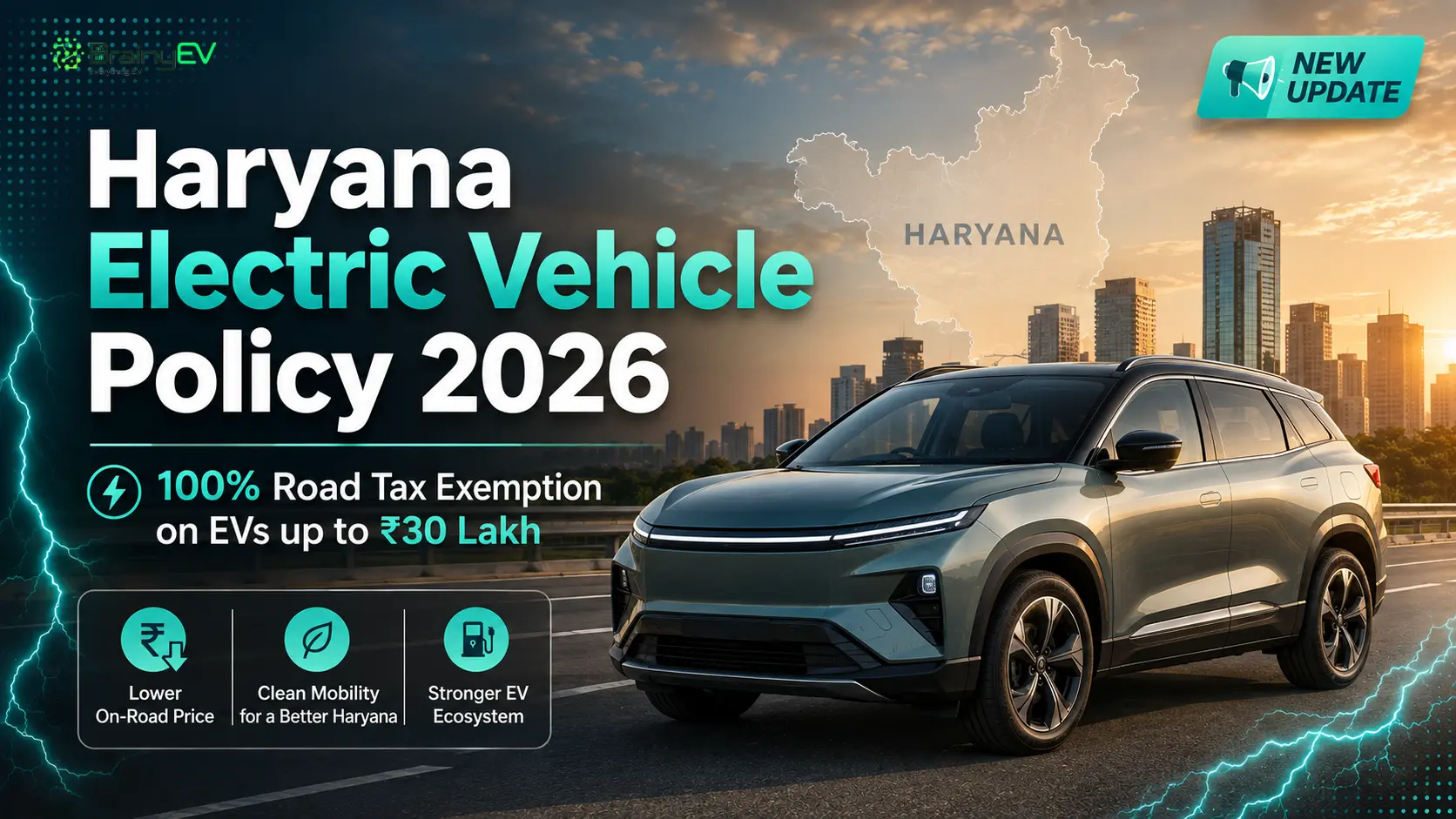
The Haryana Cabinet, led by CM Nayab Singh Saini, has approved a 100 percent road tax exemption on electric vehicles priced up to ₹30 lakh (ex-showroom). This isn’t a minor tweak. It takes the state’s earlier 20 percent one-time tax rebate on EVs and turns it into a full waiver. It’s arguably the most consumer-friendly move in the Haryana Electric Vehicle Policy since the state first started incentivising EVs
What the EV Policy Haryana 2026 Update Actually Says
Here’s the short version. Under the revised EV Policy Haryana 2026 framework, which fulfils an announcement CM Saini made in the state’s 2026-27 Budget back in March, the government has approved:
- 100% exemption on Motor Vehicle Tax for new battery electric two-wheelers, three-wheelers (autos and e-rickshaws), and four-wheelers priced up to ₹30 lakh ex-showroom.
- 50% tax exemption for EVs priced above ₹30 lakh.
- No change to the existing 20% one-time tax concession that CNG vehicles get, which stays as is.
The Cabinet also cleared a separate benefit: a 1% rebate on motor vehicle tax for non-transport vehicles up to ₹20 lakh registered in a woman’s name. Nice add-on, though it’s a different scheme and shouldn’t be confused with the EV exemption itself.
What I find notable is the ₹30 lakh threshold. It’s wide enough to cover almost every mass-market EV sold in India today. We’re not talking about some narrow slab that only benefits a handful of buyers. Whether you’re eyeing a Tata Punch EV or a fully loaded Mahindra XEV 9e, you’re likely covered.
The Real-World Math: What You Actually Save
Road tax in most states runs anywhere from 6% to 10% of the ex-showroom price for private vehicles, depending on the price bracket and fuel type. On an EV priced at ₹20 lakh, that’s a saving of roughly ₹1.2–2 lakh right at the point of registration, money that used to disappear into the RTO counter and now stays in your pocket.
For someone buying a ₹15 lakh Tata Curvv EV or Hyundai Creta Electric, the road tax saving alone could be enough to cover a home charger installation, a year or two of insurance, or simply bring the on-road price close to what a comparable petrol SUV would cost. That’s the real unlock here; it’s not about EVs becoming “cheap,” it’s about the total cost gap with petrol and diesel shrinking to a point where the switch stops feeling like a financial stretch.
Who benefits most? Honestly, it’s the middle of the market, buyers looking at ₹12–25 lakh SUVs and sedans who were on the fence. At the very entry level (sub-₹10 lakh EVs like the Tata Tiago EV or MG Comet EV), the road tax saving in absolute rupee terms is smaller, so the policy’s impact is proportionally bigger higher up the price ladder.
How Haryana Stacks Up Against Delhi
It’s worth putting this in context, because Haryana isn’t operating in isolation. It’s competing for EV buyers and dealerships with its neighbours.
Delhi rolled out its own EV Policy 2026 on July 1, offering a 100% road tax and registration fee waiver on EVs up to ₹30 lakh, plus a scrappage incentive of up to ₹1 lakh for buyers who trade in an old petrol or diesel vehicle. Interestingly, Delhi’s policy is stricter in one sense. It excludes hybrids entirely and applies a three-year lock-in to prevent people from re-registering vehicles elsewhere to game the system.
Put side by side, Haryana’s move essentially brings it to parity with Delhi on the road tax front, at a time when both neighbouring markets had started to look more attractive to EV buyers. For someone commuting across the NCR, say, living in Gurugram but working out of Delhi, this closes a gap that used to nudge people toward registering vehicles in Delhi instead.
Across Segments: Two-Wheelers, Passenger Cars, and Premium EVs
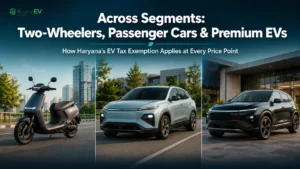
The policy doesn’t play favourites by vehicle type, and that’s a deliberate choice.
Two-wheelers and three-wheelers, e-scooters, e-bikes, autos, and e-rickshaws get the same 100% exemption as cars, provided they’re priced under ₹30 lakh, which, let’s be honest, covers essentially every two-wheeler on sale. For daily commuters and last-mile delivery riders, this is where the volume impact will likely show up first, since two-wheelers already make up the bulk of EV registrations in India.
Mainstream passenger vehicles, the ₹10–25 lakh SUVs and hatchbacks, are where the policy will probably move the needle most in terms of buyer sentiment, simply because this is where most private car buyers actually shop.
Premium EVs above ₹30 lakh still get a 50% exemption, which softens the blow for buyers eyeing something like a Kia EV6 or a higher-spec BYD Atto 3, even if they don’t get the full waiver.
Subsidy on EV Cars in Haryana: Where This Fits in the Bigger Picture
It’s worth being precise about terminology here, because “subsidy” and “tax exemption” often get used interchangeably, but they’re not quite the same thing. What Haryana has announced is a tax exemption. You don’t pay road tax at registration, but rather a direct cash subsidy credited to your bank account.
That said, when people search for subsidy on EV cars in Haryana, this is usually the benefit they’re actually referring to, and in practical terms, it functions the same way: it lowers your total on-road cost without you having to apply for a separate rebate or wait for reimbursement. Combine this with the central government’s 5% GST rate on EVs (against 28% plus cess for petrol and diesel cars) and the PM E-DRIVE scheme’s incentives for two- and three-wheelers, and you get a layered set of benefits that meaningfully closes the price gap with conventional vehicles.
One thing to watch: state incentive schemes tend to have fine print, model eligibility lists, registration conditions, and sometimes caps on the number of vehicles covered. It’s worth checking the official notification or asking your dealer directly rather than assuming every EV on the market automatically qualifies.
If you’re in Haryana and have been sitting on an EV decision, this is probably the strongest financial argument yet to stop waiting. A full road tax waiver on anything up to ₹30 lakh covers the overwhelming majority of EVs sold in India today, and it brings the state in line with what Delhi and Maharashtra are now offering.
That doesn’t mean every EV is the right fit for every buyer; charging access, typical daily distance, and resale value still matter, and no tax policy changes those fundamentals. But the upfront cost barrier just got noticeably smaller. If your only hesitation was the price gap, it’s time to run the numbers again.