29,000+ – Public charging stations in India
1:235 – Charger-to-EV ratio (vs 1:20 global benchmark)
₹500 – Avg monthly cost, home charging
2.3% – Annual battery degradation with heavy fast charging
Most Indian EV owners don’t think about how they charge, they just plug in and hope for the best. But your charging habits directly decide how long your battery lasts, how much you spend every month, and whether your EV still performs strongly in year five or feels sluggish by year three.
In 2026, India has crossed 29,000 public stations, a six-fold jump from 2022, and yet the charger-to-EV ratio sits at roughly 1 per 235 vehicles. The infrastructure is real, but it’s not quite where it needs to be.
What You’re Actually Comparing
Slow and steady wins for daily use. Fast charging is a highway tool, not a habit.
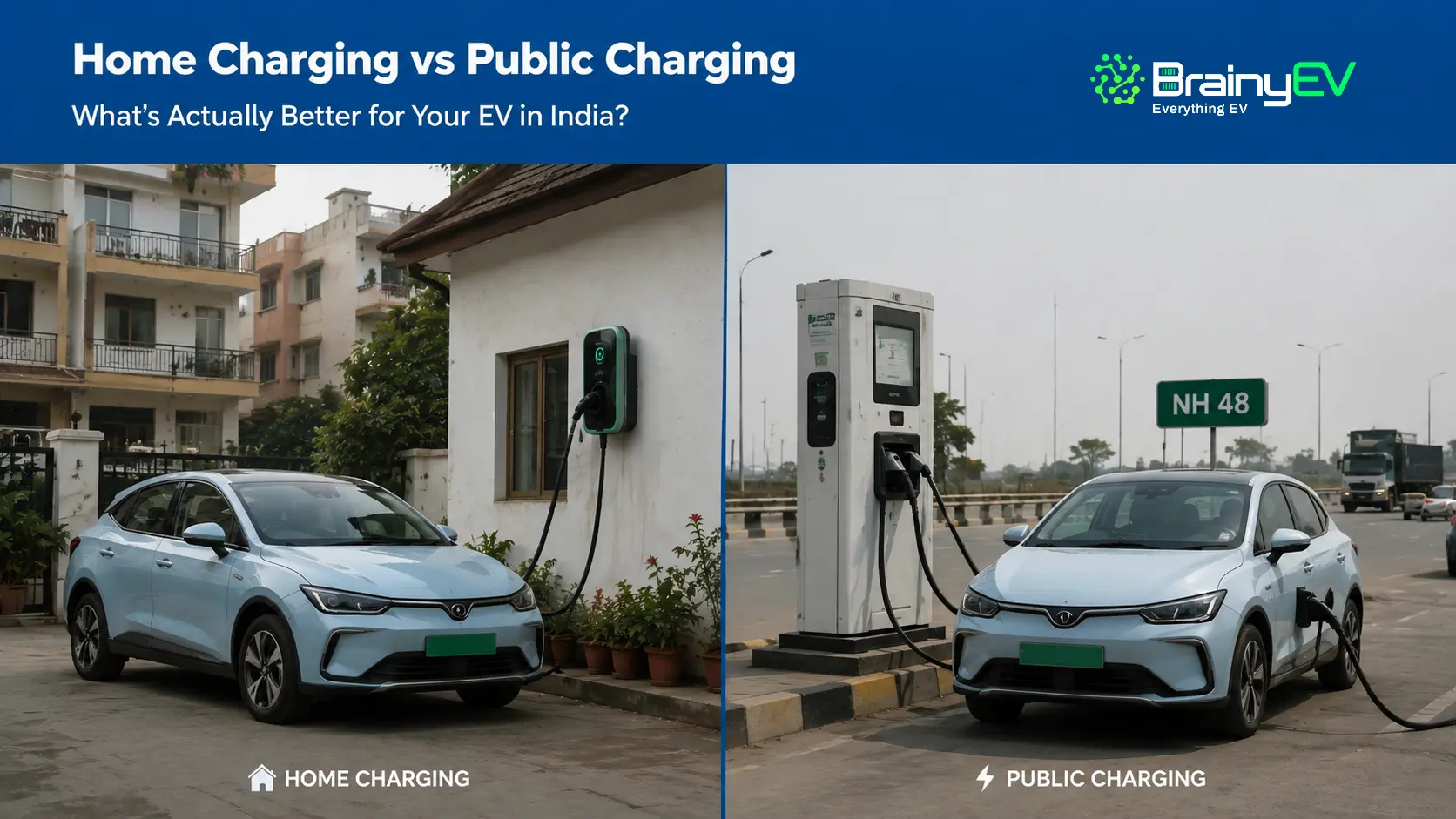
EV Home charging uses your household electricity supply through a basic socket or a dedicated wall-box, pushing 3.3-11 kW. Most full charges take 5-8 hours overnight. Slow, steady, and ideal for your battery.
Public charging comes in two types.
- AC chargers (typically 2–22 kW) provide a similar charging experience to home AC wallbox chargers. They are commonly found at commercial and public locations such as malls, workplaces, metro stations, parking garages, and sometimes fuel stations.
- DC fast charging (25-100 kW+) are different altogether. They bypass your car’s onboard charger and push electricity straight to the battery, giving you 80% charge in 30-60 minutes. Essential for highway travel, but costly for daily use, and here’s exactly why.
The Real Cost: Home EV Charging in India 2026
Home charging can cost 60% less per km than public fast charging. Over a year, that gap is real money.
Residential electricity in most Indian states sits at ₹6-₹9 per kWh. Public AC chargers run ₹10-₹16 per kWh, and DC fast chargers can reach ₹20-₹22 per kWh.
For someone covering 1,200 km per month:
| Charging method | Cost per kWh | Monthly cost (approx.) |
| Home Charging | ₹6–₹9 | ₹500–₹850 |
| Public charging (AC) | ₹10–₹16 | ₹1,000–₹1,400 |
| Public fast charging (DC) | ₹16–₹22 | ₹1,500–₹1,800 |
Relying primarily on public EV charging costs ₹8,000-₹11,000 more per year than charging at home. If you have a rooftop solar setup, that gap widens further, your EV home charging cost can drop to near zero.
Thinking of installing a home charger? Read our Home EV setup guide
What Fast Charging Actually Does to Your EV Battery
DC fast charging can double your battery degradation rate. LFP batteries handle it better, but the habit still matters.
A 2026 Geotab study analysing 22,700 EVs across 21 makes and models found the average annual battery degradation rate has climbed to 2.3% per year, up from 1.8% in 2024.
A growing reliance on DC fast charging is the primary driver.
1.5%
Annual degradation when DC fast charging is under 12% of sessions.
3.0%
Annual degradation when DC fast charging exceeds 12%, especially above 100 kW.
That’s double the rate. Over 8-10 years, the difference translates to meaningfully less capacity making the car feel less capable and reducing its resale value. DC fast charging delivers high-voltage electricity directly to the battery, generating more heat and placing greater stress on the cells. This accelerates the chemical breakdown of lithium-ion batteries over time.
The good news: LFP (Lithium Iron Phosphate) batteries, the chemistry of choice in most Indian EVs in 2026, are noticeably more resistant to fast-charging degradation than NMC or NCA chemistries. A 2025 ScienceDirect study found that LFP cells showed virtually no extra degradation even under aggressive fast-charging regimes.If your EV runs LFP, you have more flexibility to use public fast charging. Still, the expert consensus holds: EV home charging via AC as your daily habit, DC fast charging for the highway.
The India-Specific Complications Nobody Tells You
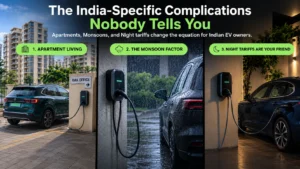
Apartments, Monsoons, and Night tariffs change the equation for Indian EV owners specifically.
Apartment living
Installing a home charger requires parking access, electrical board approval, and approval from your RWA, which can take time. Many apartment complexes haven’t figured out shared-infrastructure billing yet. If you’re in this situation, public EV charging isn’t just a backup, it’s your primary option for now.
The monsoon factor
India’s monsoons are harsh. Home charging setups must have proper earthing and surge protection, especially in older buildings. An inadequate setup isn’t just inefficient, it’s dangerous. Factor this in before installing a home charger.
Night tariffs are your friend
Many state electricity boards offer lower tariffs between 11 PM and 6 AM. Pair this with a smart charger that auto-schedules, and your home charging cost drops significantly. If you’re not using off-peak charging, you’re paying more than you need to.
The 90/10 Rule: A Framework That Actually Works
Industry experts and real-world Indian EV data both point toward the same strategy.
90% of your charging should be EV home Charging or workplace AC charging. This is cheaper, gentle on the battery, and effortless. You plug in at night, and you leave in the morning with a full charge. No queues, no app glitches, and no out-of-service surprises.
10% of your charging shall be public EV charging. Reserve DC fast charging for road trips, emergencies, or times when you’re away from home for an extended period. It’s not meant for everyday charging. Not even if there’s a fast charger in your office basement.
This approach gets you the best of both worlds: Maximum battery longevity, minimum running cost, and the freedom to go wherever you need without any range anxiety.
Is Public Charging the Right Call ?
Public fast charging isn’t the enemy. It’s just a highway tool and not a daily basis habit.
There are real scenarios where public EV charging wins, and it’s worth being honest about them. On highway travel, DC fast chargers across national corridors means you’re not stuck. A 30-minute stop for 80% charge and you’re back on the road.
If you live in a flat without a dedicated charging point, public infrastructure is your lifeline. Fleet and commercial users, delivery riders or cab drivers, simply cannot wait 6 hours for a home charge. Battery swapping networks increasingly serve this segment.
And if you’re away for 2-3 days for work, public charging keeps you moving.
The PM E-DRIVE scheme, with a ₹10,900 crore outlay targeting 72,000 public stations, with ₹2,000 crore specifically for 50 national highway corridors, is making long-distance EV travel genuinely less stressful. Operators like Tata Power EZ Charge, ChargeZone, and Jio-bp Pulse have made meaningful progress. But context matters:
India needs an estimated 1.32 million public stations by 2030 to support its 30% EV penetration target.
Today’s 29,000 needs to scale 40 times in under 5 years. Anyone waiting for public infrastructure to fully replace home charging will be waiting a very long time.
The Final Verdict
| Parameter | Home charging | Public charging |
| Cost per km | ₹0.40-₹0.70 | ₹1.20-₹1.80 |
| Battery impact | Low: Gentlest option | Moderate to high (DC fast) |
| Convenience | Highest: Plug in at home | Improving but variable |
| Charging time | 5-8 hrs (overnight) | 30-90 min (DC fast) |
| Best for | Daily commute | Long trips, emergencies |
EV Home charging is the backbone of smart EV ownership in India in 2026, cheaper, better for battery health, and genuinely effortless for daily use. Public EV charging is the infrastructure that gives you the freedom to actually go places. Use home charging for everything you can. Use public fast charging for everything you need. Build the 90/10 habit, and your EV will serve you well past 1,50,000 km.
Staying updated on India’s EV charging ecosystem? BrainyEV covers it all, from charging infrastructure and battery tech to real-world ownership costs and the smartest EV picks across budgets.
Explore more at Brainy EV