Everything you actually need to know about ev charging at home: Costs, chargers, wiring, and apartments, without the fluff
You drove your brand-new EV home. Plugged it in, using the cable that came in the box. Set it to charge overnight. Woke up excited… Saw 51% on the screen.
You did the math. At this rate, a full charge takes nearly 20 hours.
That’s not a charging setup. That’s a problem.
The good news? Getting proper home ev charging in India is more straightforward, and more affordable than most people think. Understanding the true home EV charging cost is crucial for Indian homes, Indian apartments, and Indian EVs. Most guides online are still written for the US or Europe, with different plugs, different standards, and price tags in dollars.
India is now the third-largest EV market in the world, and in 2026, EV charging infrastructure has finally started catching up. Let’s make sure yours does too.
Do You Actually Need a Dedicated Charger?
If you drive a 4-wheeler EV and commute more than 40 km a day, yes, absolutely.
Here’s why. A standard 15-amp socket delivers about 1.5 to 2 kilowatts of power. That sounds fine until you realise a Tata Nexon EV has a 45 kWh battery, the MG Windsor EV carries 38 kWh, and the Hyundai Creta EV packs 51.4 kWh. Do the division on any of those and you’re looking at 20+ hours on a regular socket.
Plug that same Nexon into a 7.2 kW home wall box? Done in about 6.5 hours. Overnight. Every night. Wake up to a full battery like it’s the most normal thing in the world, because in 2026, it genuinely should be.
If you own a 2-wheeler EV like an Ola S1 or Ather 450X, a 15-amp socket is honestly fine. But for 4-wheelers, you need a dedicated electric car charger at home.
Not sure how much range your EV is actually getting, daily?
Use the Brainy EV Range and Cost Calculator
Types of Home EV Chargers in India (2026)
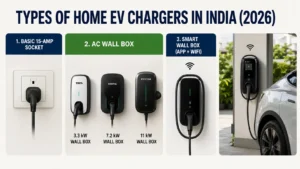
The Basic 15-Amp Socket (Which You Already Have)
- Speed: 1.5-2.5 kW
- Best for: 2-wheelers, plug-in hybrids, emergency top-ups
- The risk: Your wiring isn’t designed for sustained high loads overnight. Older wiring especially, it’s a risk you simply don’t need to take.
The AC Wall Box: This Is What You Actually Want
The sweet spot for the vast majority of Indian EV owners. Finding the right electric car charger wall box is essential. It’s wall-mounted, installed near your parking spot, fast and safe enough for daily use.
3.3 kW Wall Box
- Charges most EVs fully in 8-12 hours overnight
- Fine for daily commutes under 60 km
- Brands: Tata AC001, Exicom 3.3 kW, Okaya 3.3 kW
- Price (2026): ₹12,000 – ₹20,000
7.2 kW Wall Box
- Charges most EVs in 5-8 hours, the overnight sweet spot
- Future-proof: works for the next EV you buy too
- Brands: Statiq Home, ChargeZone Home, Exicom 7.2 kW, Delta AC Mini, Lectrix
- Price (2026): ₹20,000 – ₹38,000
11 kW Wall Box (Now More Accessible)
- Once a premium niche, now entering mainstream availability in India
- Charges vehicles like Hyundai Creta EV, BYD Atto 3, and Kia EV6 significantly faster
- Requires a 3-phase power connection, available in most urban homes and societies
- Brands: Exicom 11 kW, Kazam, Servotech
- Price (2026): ₹35,000 – ₹60,000
Smart Wall Box (App + WiFi)
- Any of the above with scheduling, consumption tracking, remote access
- Increasingly standard rather than premium in 2026
- Price premium over basic: ₹5,000 – ₹10,000 more
DC Fast Charger at Home: Still Not Worth It
A public dc fast charger is great for road trips, but what about a dc fast charger at home? Even in 2026, these cost ₹2 lakh to ₹6 lakh+ and are overkill for personal home use. Skip it.
On connectors: Most Indian 4-wheeler EVs, Nexon EV, Tiago EV, MG Windsor, Hyundai Creta EV, BYD Atto 3, use a Type 2 (Mennekes) connector for AC home charging. CCS2 is the DC fast charging standard mandated by BIS. Ola S1 and Ather still use proprietary/15A setups. Always verify before buying a wall box.
The Real Cost Breakdown (2026 Prices)
Here is a detailed look at the true home ev charging cost:
| What You’re Paying For | 2026 Cost Range |
| 3.3 kW Wall Box | ₹12,000 – ₹20,000 |
| 7.2 kW Wall Box | ₹20,000 – ₹38,000 |
| 11 kW Wall Box | ₹35,000 – ₹60,000 |
| Smart Charger Add-on | ₹5,000 – ₹10,000 extra |
| Standard Installation (wiring + MCB) | ₹4,000 – ₹10,000 |
| With Earthing Work | ₹6,000 – ₹14,000 |
| Apartment with Long Cable Run | ₹12,000 – ₹28,000 |
| Load Sanction from DISCOM (if needed) | ₹3,000 – ₹10,000 |
Total realistic budget for a 4-wheeler EV owner: ₹30,000-₹60,000 all-in.
Prices have nudged up slightly from 2024 due to component costs, but installation has become more competitive as more certified installers enter the market, especially in Tier 1 and Tier 2 cities.
One thing many people still miss is, “check with your OEM first”. In 2026, Tata Motors, MG Motor, Hyundai, BYD, and Mahindra all offer home charger packages tied to their vehicle purchase, often at subsidised rates or bundled with free installation. Don’t pay full market price before asking your dealership.
What Does It Cost Per Charge? (2026 Electricity Rates)
Domestic electricity tariffs have risen modestly in many states, but home EV charging remains highly economical. Using a realistic average of ₹7-9 per unit in 2026:
- Tata Nexon EV (45 kWh): ₹315-405 per full charge (ARAI range: Up to 489 km)
- MG Windsor EV (38 kWh): ₹266-342 per full charge (ARAI range: Up to 331-332 km)
- Hyundai Creta EV (51.4 kWh): ₹360-463 per full charge (ARAI range: Up to 510 km)
Your cost per km at home: typically ₹0.65-1.20 (depending on efficiency and tariff).
Compare that to a petrol car at ₹105-110/litre with 15 kmpl efficiency: ₹7-7.3 per km. The cost advantage of home EV charging remains very strong and has widened.
What Your Home Electrically Needs
For Independent Houses and Villas
You need a dedicated circuit from your main distribution board (DB) to your charging point. 16A single-phase for 3.3 kW, 32A single-phase for 7.2 kW, 16A three-phase for 11 kW.
Three safety essentials are non-negotiable: An MCB (which trips during an overload or short circuit), an RCCB (which trips when it detects current leakage, the kind that can cause electric shock), and proper earthing. If your electrician doesn’t mention earthing before you do, it’s worth finding another one. And if your home’s wiring is more than 10 years old, have it inspected before installing an EV charger.
For Apartment and Flat Owners
This is where it gets complicated, and where most guides still leave you hanging.
Installing a home charger in an apartment means navigating your housing society, your DISCOM, and local regulations. It’s not impossible. Far more apartment dwellers have done it in 2026 than in previous years, but it still takes effort.
The steps you’ll need:
- Get written permission from your RWA before spending anything.
- Check if your parking area has power supply, most societies built after 2022 are EV-ready.
- Apply to your DISCOM for a separate sub-meter or load enhancement.
- Know your rights, Maharashtra’s MRERC, Karnataka’s KERC, and Delhi’s DERC all have frameworks supporting apartment EV charging. If your society is being obstructive, you have regulatory grounds to push back.
- Use a portable EVSE as a stopgap while paperwork resolves.
In 2026, several states have also mandated EV charging provisions in new residential construction. Newer buildings have fewer excuses.
Step-by-Step: How the Installation Works
Step 1: Assess your setup
Check your main DB for spare MCB slots and your electricity bill for sanctioned load. If you’re close to capacity, apply for a DISCOM load enhancement first, timelines have improved to 2-4 weeks in most cities.
Step 2: Choose your charger
For commutes under 80 km, 3.3 kW is enough. For future-proofing, go 7.2 kW. If you have 3-phase supply and a larger EV like the Creta EV or BYD Atto 3, consider 11 kW. Always check OEM bundles before buying third-party.
Step 3: Find a qualified installer
Go for OEM-authorised installers, Tata Power EV, ChargeZone, Statiq, Exicom, and Kazam all offer home installation in 2026. Brands that bundle installation with purchase are often the cleanest option. Red flags to look out: Any installer who doesn’t mention earthing, or quotes you without inspecting your DB.
Step 4: The installation
Standard job: 3 to 6 hours. Wall mounting, conduit wiring to DB, MCB and RCCB, earthing, test charge run. Do not let the installer leave without a test run.
Step 5: Set up smart scheduling
Schedule charging after 11 PM, lower tariffs, less grid load, and your car sits idle anyway. In 2026, app connectivity comes standard on most wall boxes.
The State-Level EV Tariff Most People Still Don’t Know About
If you’re not using this, you’re overpaying.
Several DISCOMs across India have EV-specific home charging tariffs. Updated figures for 2026:
- BESCOM (Karnataka): ₹5.00/unit for registered home EV chargers.
- TPDDL (Delhi): ₹4.75/unit EV-specific tariff.
- MSEDCL (Maharashtra): EV home tariff available, approximately ₹5.50/unit (check current slab).
- TNEB (Tamil Nadu): EV charging tariff under the 2023 EV Policy, still active.
- KSEB (Kerala): EV-specific tariff introduced in 2025, approximately ₹5.25/unit.
At ₹5/unit instead of ₹8/unit, charging a Nexon EV costs ₹202 instead of ₹324. That’s over ₹1,800 a month in savings, just for registering your charger with your DISCOM. It takes 15 minutes. Do it.
How Long Does Charging Take? (2026 EV Models)
| Vehicle | Battery | 3.3 kW | 7.2 kW | 11 kW |
| Tata Nexon EV | 45 kWh | 13 hrs | 6.5 hrs | N/A (single-phase OBC) |
| Tata Tiago EV | 24 kWh | 8 hrs | 4 hrs | N/A |
| MG Windsor EV | 38 kWh | 12 hrs | 6 hrs | N/A |
| Hyundai Creta EV | 51.4 kWh | 16 hrs | 7.5 hrs | 5 hrs |
| Mahindra BE 6 | 59 kWh | 18 hrs | 8.5 hrs | 5.5 hrs |
| BYD Atto 3 | 60.5 kWh | 19 hrs | 9 hrs | 6 hrs |
| Ola S1 Pro | 4 kWh | 1.5 hrs | N/A | N/A |
| Ather 450X | 3.7 kWh | 1.5 hrs | N/A | N/A |
Times vary based on your vehicle’s onboard charger (OBC) capacity and starting battery level.
Quick Safety Checklist
- Never use an extension cord. Use an IP54-rated charger for outdoor or covered parking, especially through monsoon.
- Keep a CO2 fire extinguisher nearby. If you smell burning or hear buzzing, unplug first, call your installer second.
- And if the power cuts mid-charge, don’t worry, your EV’s BMS handles it safely every time.
The Bottom Line
In 2026, home EV charging in India is more accessible, better supported, and faster to set up than it’s ever been. Most 4-wheeler EV owners need a 7.2 kW wall box, a certified installer, a dedicated circuit with earthing, and a budget of ₹30,000-₹60,000 all-in. That one-time investment pays itself back in fuel savings within 12-18 months, sometimes sooner if you’re on a state EV tariff.
If you’re in an apartment, it takes more patience, but the regulatory environment is firmly on your side now.
The biggest mistake you can make is still doing nothing. Your EV deserves better. More practically, you deserve to wake up to a full battery every morning.
Set it up once. Charge every night. Never think about it again.
Make Smarter EV Decisions with Brainy EV
Still wondering how far your EV can actually go on a full charge? Which charger genuinely fits your driving pattern? Whether that highway trip is doable without a mid-route stop?
BrainyEV has tools built specifically for Indian EV owners in 2026, no guesswork, just answers.
Calculate your real-world EV range
Find the nearby EV stations to charge your EV
Plan your next EV road trip, stop by stop
Curious what your EV is really capable of? Find out at Brainy EV.
Related reads: