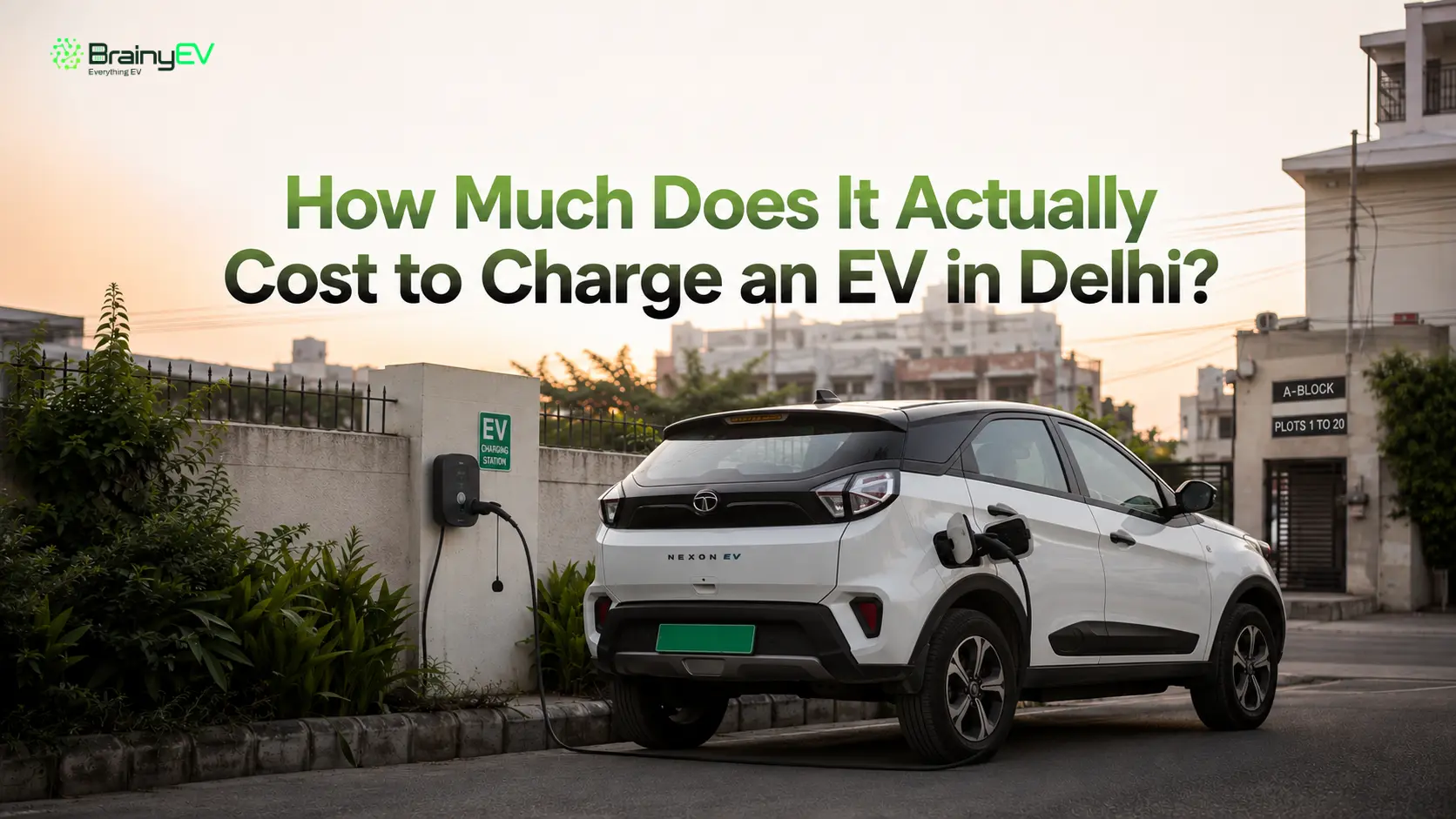
If you live in Delhi and are considering an electric vehicle, one practical question comes up again and again: What is the real EV charging cost in Delhi?
The short answer is reassuring. For most households, charging at home keeps the daily running costs low, predictable and far more economical than petrol or diesel, especially when you make smart use of overnight sessions.
Delhi’s power setup works in your favour. The Delhi electricity tariff follows a slab system managed by the city’s DISCOMs, BSES Rajdhani, BSES Yamuna and Tata Power-DDL, all operating under the same DERC-approved rates. The first 200 units are billed at around ₹3 per unit, the next band up to 400 units at roughly ₹4.50, then about ₹6.50 for units between 401 and 800, and ₹8 per unit beyond that.
If your total monthly consumption, home plus EV charging, stays under 400 units, you may also qualify for the Delhi government’s subsidy, which can make your effective cost even lower. For most EV owners charging at home, this slab structure means the car adds a modest, predictable amount to the bill rather than pushing you into the steeper higher-consumption rates.
Fixed charges, electricity duty and the Power Purchase Adjustment Cost (PPAC) also apply and can raise the effective rate. Because these elements vary by DISCOM, month and exact usage, most EV owners experience an all-in EV charging cost per unit of roughly ₹6-9 when the vehicle’s consumption sits in the mid-to-higher slabs.
Understanding EV Charging Cost at Home
The Cost of Charging an EV at Home Depends on the Electricity Slabs, with a Full Charge Costing Around ₹200 under 400 Monthly Units and Around ₹400 in Higher Consumption Slabs, While Still Remaining Cheaper than Petrol
The lowest EV charging cost at home comes from plugging into your domestic connection, though the exact number depends heavily on which slab your total household consumption falls into.
If your home usage plus EV charging stays under 400 units a month, a full charge on a compact or mid-size EV (30-45 kWh usable battery) can cost as little as ₹100-200, working out to roughly ₹0.50-0.80 per kilometre.
But regular driving of 800-1,200 km a month typically adds 150-250 extra units to your bill, which can push part or all of your consumption into the higher 401+ unit slabs. In that case, a full charge costs closer to ₹250-400, and the effective cost rises to about ₹1-1.50 per kilometre.
Either way, that’s a fraction of what a comparable petrol car costs at current fuel prices. Your exact figure depends on two things:
- How many units your household already consumes.
- How often you charge your EV.
Even at the upper end of this range, home charging remains significantly cheaper than running a petrol vehicle, and unlike a fuel bill, the extra cost shows up as a predictable, transparent addition to your electricity bill rather than a surprise.
Why Overnight EV Charging Makes Sense
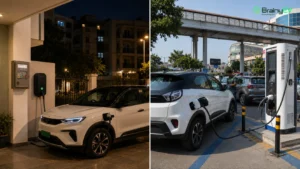
Charging EVs Overnight: Lower Charging Costs, Improved Battery Health, and Greater Convenience for Everyday Driving
Overnight EV charging is the most practical and cost-effective habit for Delhi residents. Most people park the car after work, plug in, and wake up to a full battery.
Slow AC charging overnight is gentle on the battery and aligns well with typical residential load patterns. In some cases, time-of-day considerations or future differential tariffs being explored by DISCOMs may further improve the economics of night charging.
Because the Delhi electricity tariff is already structured around progressive slabs, spreading the charge over several hours at home avoids the higher rates charged at public DC fast-charging stations. Those public points commonly work out to ₹15-25 per unit, so a full charge can cost two to three times more than the same energy drawn at home.
Everyday commuting, therefore, stays cheapest when you rely on the EV charging cost at home and reserve public stations for longer trips.
Putting the Numbers in Everyday Perspective
Consider a common scenario. You drive 800-1,200 km a month in Delhi traffic. At an approximate home rate of ₹7-8 per unit and realistic energy use of 0.15-0.18 kWh per kilometre, your monthly electricity outlay for the car often lands between ₹850 and ₹1,750.
The same distance in a petrol car of similar size can easily cost several times that amount. Over a year, the difference becomes substantial, and the savings continue for as long as you own the vehicle.
The EV charging cost per unit you actually pay is therefore not a fixed published figure but a practical average that most owners can keep well under control. Tracking your monthly units for a couple of billing cycles quickly shows you the real impact of the EV on your household bill.
Once you see the pattern, overnight EV charging becomes second nature, and the overall EV charging cost in Delhi starts to feel more transparent and manageable.
Making the Most of Delhi’s Growing EV Ecosystem
Delhi continues to expand its charging network and has introduced supportive policy measures that encourage private and community chargers in residential societies. This makes home and society-based charging even more convenient.
The combination of a relatively favourable Delhi electricity tariff structure and the ability to charge overnight means that most owners experience electric mobility as both cleaner and cheaper on a day-to-day basis.
If you are still comparing models or want a clearer picture of running costs for the specific EV you are considering, reliable tools and local insights can help.
Visit BrainyEV to explore vehicle comparisons, charging cost calculators and practical guidance tailored to Indian cities in general. Understanding the approximate EV charging cost in Delhi, the EV charging cost per unit you are likely to see, and the advantages of EV charging cost at home through regular overnight EV charging puts you in a strong position to make it a confident and informed choice.
Electric driving in Delhi already delivers lower running costs for the majority of users who charge at home. With a little attention to your household slab and a consistent overnight routine, those savings become part of your everyday life.
Related Reads: