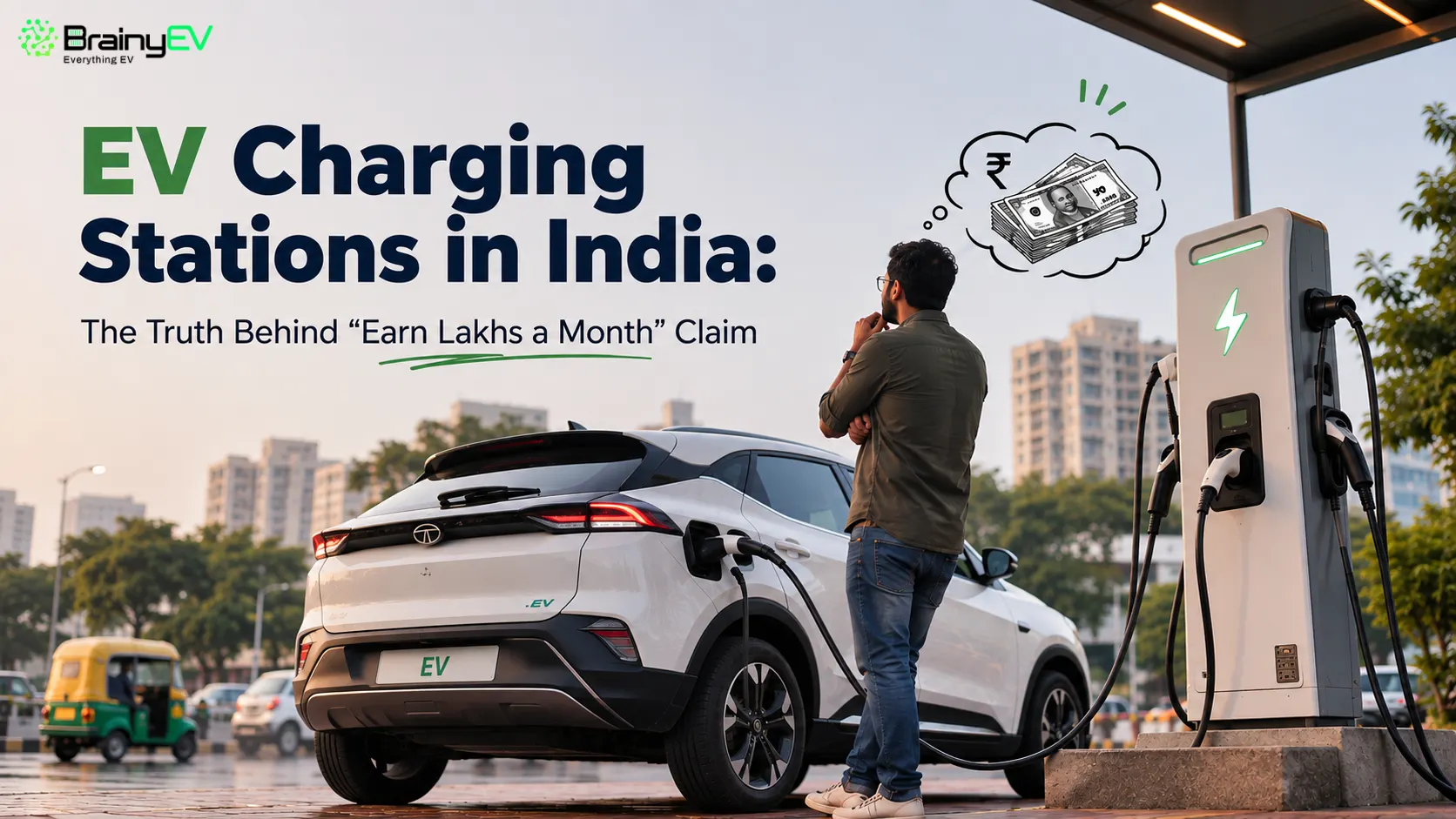
Scroll through Instagram these days, and you’d probably end up coming across it. A promise that sounds too good to pass up: Start an EV charging station for just 2-3 lakhs, let the government cover the rest, and watch 4-5 lakhs roll in every month.
It’s a nice story, but unfortunately, it’s not the full one.
Here’s the good news first: the opportunity underneath all that hype is real. The EV charging stations in India are genuinely short on infrastructure, EV sales are climbing fast, and the government has put serious money behind fixing the gap. You just need the actual numbers, not the marketing version.
The scheme that’s really running
The central government’s flagship program here is called PM E-DRIVE, the Electric Drive Revolution in Innovative Vehicle Enhancement scheme. It kicked off in October 2024, carries a total outlay of ₹10,900 crore, and sets aside ₹2,000 crore specifically for public charging infrastructure, aiming to support over 72,000 EV charging stations across the country.
But the subsidy inside this scheme isn’t a flat percentage for everyone, which is where a lot of these viral posts start stretching the truth. The guidelines actually split it by location type. Government offices, schools, hospitals, and residential colonies get a full 100% subsidy on both the equipment and the wiring behind it, but only if they keep the charger open to the public for free. High-traffic public spots like airports, railway stations, metro stations, bus depots, and toll plazas get up to 80% on the infrastructure and 70% on the charger itself. A regular private or commercial setup, the kind an individual entrepreneur would actually build, doesn’t automatically qualify for either tier.
What that setup usually gets instead is a smaller state-level capital subsidy, typically somewhere between ₹1 lakh and ₹10 lakh depending on the state and the type of charger. In Delhi specifically, the Delhi EV Policy 2026 offers a 100% subsidy up to ₹6,000 per charging point, but only for the first 30,000 slow and medium chargers installed at homes, apartments, and commercial premises- a genuinely useful benefit that also covers an EV home charger, just nowhere near “the government pays 80% of your station.”
There’s also a practical detail that rarely makes it into the ad: Individuals generally can’t apply for the bigger subsidy tiers directly. Those applications run through government-appointed nodal agencies. In Delhi’s case, that’s Delhi Transco Limited. So the process is slower and more paperwork-heavy than “invest and collect.”
Where the real money comes from
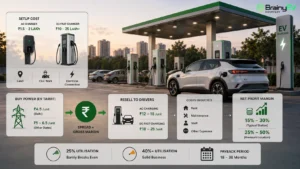
Setting up a station costs less than most people assume for the basic version. A standard AC charger runs about ₹1.5-2 lakh. A DC fast charger, the kind that charges a car in under an hour, costs anywhere from ₹10-25 lakh depending on its power rating, plus whatever you spend on land, civil work, and the electrical connection itself.
The earning side works on a simple spread. You buy power from your DISCOM at a discounted EV tariff, around ₹4.5 per unit in Delhi, ₹5-6.5 in most other states, and resell it to drivers at ₹12-18 per unit for an AC charger, or ₹18-25 for a DC fast charger. That gap between what you pay and what you charge is your gross margin, before rent, maintenance, and staff costs come out of it.
After those costs, industry numbers put net profit margins around 15-30% for a typical set of EV charging stations, climbing to 25-50% at premium, high-footfall locations. On a well-run station, that can translate to a genuinely comfortable monthly income, but nothing close to “4-5 lakhs guaranteed.” It depends heavily on one factor above all: how many cars actually pull in and plug up.
A station running at 25% utilisation barely covers its costs; one running at 40% or more starts looking like a solid business. Most operators expect a payback period of 18 to 36 months, not weeks.
Most small operators start with one or two AC charger units because the investment and electrical load are easier to manage
Is an EV Charging Station Worth the Investment
EV charging stations in India are a real, growing business with genuine government backing, and someone who does their homework on location, tariffs, and the correct subsidy tier can build something profitable. What it does mean is: treat the flashy “guaranteed lakhs” posts as marketing, not financial advice. Check subsidy eligibility on the official PM E-DRIVE and your state EV policy portals, talk to your DISCOM about the actual connection process, and never pay a private “agent” upfront for a subsidy they’re promising to arrange. An EV home charger remains far cheaper to set up than a public station and still benefits from the discounted EV electricity tariff, while public EV charging stations need careful location planning.
The opportunity doesn’t need exaggeration to make sense. The real numbers are good enough on their own.
Want to make smarter EV decisions?
Whether you’re exploring an EV, comparing models, looking for charging stations, calculating running costs, or keeping up with the latest policies and opportunities, BrainyEV brings the entire electric mobility ecosystem together in one place.
Explore reliable insights, practical tools, and trusted real-world EV information to move beyond the hype and make EV decisions with confidence.
Head over to BrainyEV today and discover everything EV, all in one platform.
You may also like:
PM-E Drive Scheme 2026
Delhi’s New EV Policy 2.0