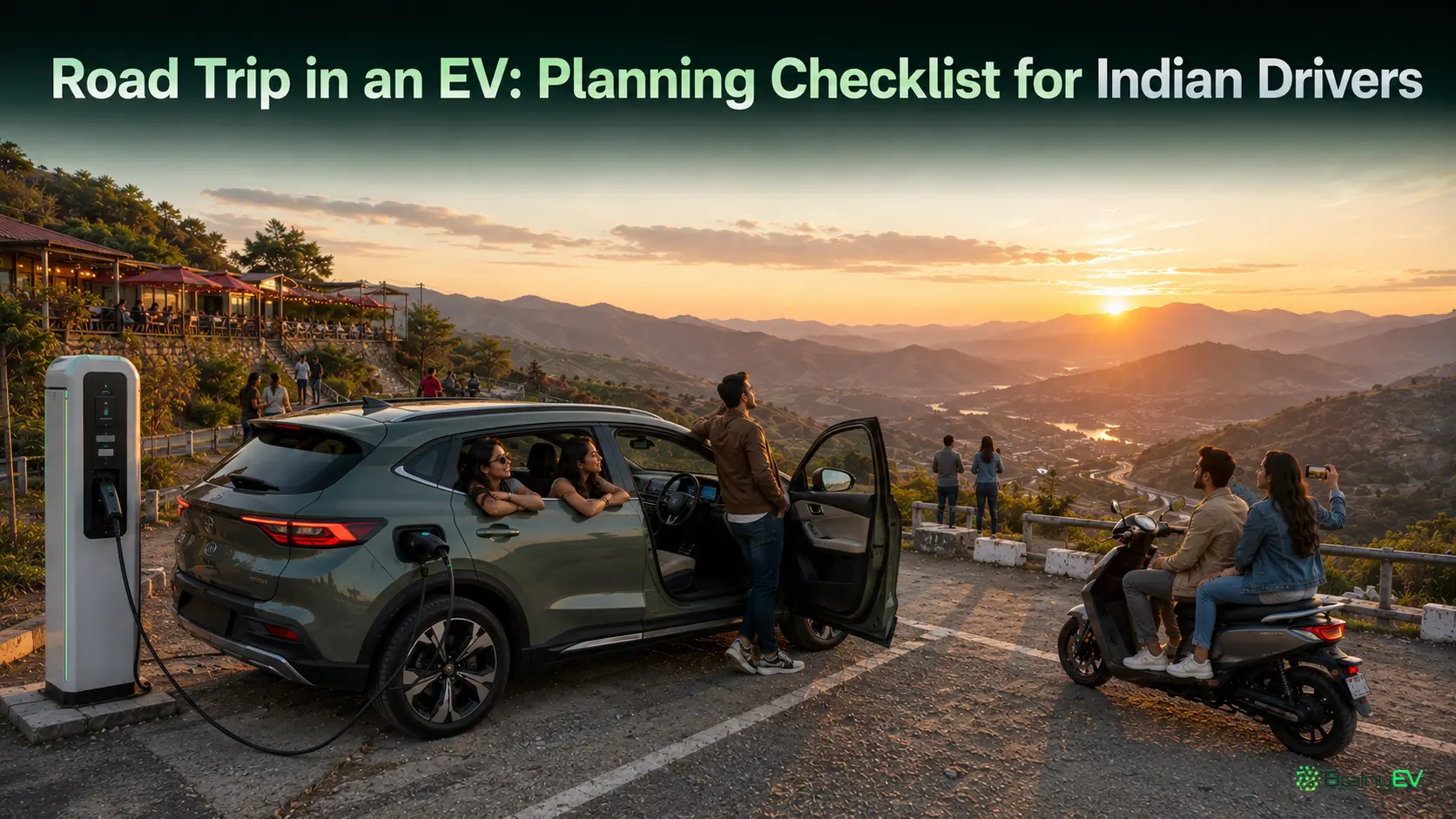
Taking an electric vehicle on a long road trip across India is no longer a rare experiment. By mid-2026, India had more than 52,000 public charging stations, including over 16,500 fast chargers, and roughly 91% of national highways have a charger within every 50 km on most major corridors. Still, range depends on speed, terrain, weather and load, so solid preparation matters. This checklist covers the practical steps Indian EV owners need for a smooth journey.
Know Your Real-World Range First
Manufacturer range figures are optimistic. Highway speeds of 100-120 km/h, continuous AC use in summer, or hills can cut effective range by 20-30% or more. Plan legs of 200-250 km and keep a buffer so you arrive at chargers with 20-25% battery left.
Cold weather EV range is another factor, especially on North Indian routes or Himalayan stretches in winter. Temperatures of 5-12°C can reduce range by roughly 10-15% because battery chemistry slows and cabin heating draws extra power; losses climb toward 25-30%+ only closer to freezing (0°C and below).
Precondition the battery if your car supports it, use seat heaters instead of full cabin heat where possible, and subtract extra margin from your estimates. Regenerative braking helps on downhill sections, but cold batteries accept less charge, so expect lower recovery.
Use Proper EV Route Planning Tools
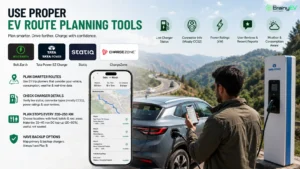
A Smarter Route Means a Smoother Journey: Map Charging Stops, Verify Availability, and Always Have a Backup Plan
Good EV route planning is the foundation. Do not rely only on Google Maps. Cross-check with apps that show live charger status, connector types (mostly CCS2 for cars), power ratings and recent user reports.
Popular options in 2026 include Bolt. Earth, Tata Power EZ Charge, Statiq and ChargeZone. An EV trip planner that factors in your specific model’s consumption, current charge level and weather gives more accurate stop suggestions. Map primary and backup chargers every 200–250 km, preferably at places with food, toilets or rest areas so the 30–45 minutes needed for a 20–80% DC top-up feels useful rather than wasted.
Look for a current list of EV charging stations in India along your corridor. Major highways such as NH-48 (Delhi–Mumbai/Jaipur), the Mumbai-Pune Expressway and parts of NH-44 now have denser coverage from Tata Power, BPCL, ChargeZone and others. Bengaluru–Mysuru is improving but still has stretches with gaps of around 100 km, so plan backup stops more conservatively on that route.
Coverage is thinner in the Northeast, high-altitude Himachal/Uttarakhand stretches and some central corridors, so verify before you leave.
Plan your next EV road trip with accurate charging stops.
Use the BrainyEV Trip Planner to map your route, find reliable chargers, and travel with confidence.
Planning your first long drive or daily commute on an EV becomes simple when you have the right tools. With BrainyEV you can:
Plan your entire route in advance.
Locate nearby charging stations along the way
With real-time availability checks, you can travel with complete confidence and never worry about range. Open BrainyEV today, map your journey, and experience how effortless electric driving can be.
Charging Infrastructure for Electric Vehicles in India and Stop Strategy
The charging infrastructure for electric vehicles in India has expanded rapidly under schemes such as PM E-DRIVE, but reliability still varies. Always check the “last used” or live availability status in apps rather than trusting a map pin alone. This matters more than it sounds, as a meaningful share of listed public chargers nationwide are non-operational at any given time, so live status checks aren’t optional, but they’re the difference between a smooth stop and a stranded one.
Prefer stations with multiple DC fast chargers (25-150 kW) over single-point locations.
Follow the 20–80% rule on fast chargers: arriving around 20% and leaving at 80% is usually the quickest turnaround. Full charges take longer because the rate slows above 80%. Carry your CCS2 cable, a 16A portable charger and necessary adapters. Many hotels, dhabas and resorts now offer 15A/16A sockets that work for slower overnight top-ups.
When searching for EV charging stations in India, note that operators such as Tata Power EZ Charge, ChargeZone, Statiq, BPCL Charge+ and Jio-BP Pulse dominate highways and cities. Keep at least two apps loaded and payment methods ready.
Need a charger right now?
Find Nearby EV Charging Stations on BrainyEV and check what’s available around you.
Prepare the Car and Pack Smart
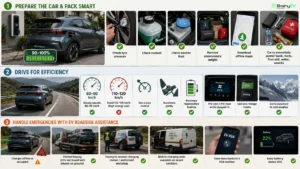
Do Proper EV Checks, Maximise Driving Efficiency, and Stay Prepared with Roadside Assistance for Unexpected Situations
Charge to 90-100% before the first leg. Check tyre pressure (correct pressure improves efficiency), coolant and washer fluid. Remove unnecessary weight. Download offline maps for stretches with poor networks. Carry a power bank, basic tools, a first-aid kit and enough water and snacks.
Drive for Efficiency
Steady speeds around 80-90 km/h use noticeably less energy than 110-120 km/h. Use cruise control on open highways, accelerate gently and maximise regenerative braking. Pre-cool or pre-heat while still plugged in. Eco or range modes help. In cold weather EV range conditions, these habits become even more important.
Handle Emergencies with EV Roadside Assistance
Even with good planning, a charger can be offline or occupied. Most manufacturers and many insurance policies include EV roadside assistance that covers flatbed towing (EVs should not be towed with wheels on the ground) to the nearest charging station or authorised workshop. Some operators also offer mobile charging units on select corridors. Save your manufacturer’s RSA number and keep the battery above 20% whenever possible. EV roadside assistance is the practical backup that turns a potential stranding into a manageable delay.
Final Checklist Before You Leave
- Confirm real-world range for your model under highway + AC/heater conditions.
- Run an ev trip planner and mark primary plus backup stops.
- Install and log into at least two charging apps; preload payments.
- Check a recent list of EV charging stations in India on your specific route.
- Pack cables, adapters, offline maps and essentials.
- Note EV roadside assistance contacts.
- Account for cold weather EV range loss if heading north or to higher altitudes.
With the current network of EV charging stations India and improving charging infrastructure for electric vehicles in India, long trips are practical on well-served corridors. Proper EV route planning and a realistic buffer turn range anxiety into routine rest stops.
Ready to plan your next drive with better data and tools? Visit Brainy EV for EV comparisons, trip planning support and clear insights that help Indian drivers make confident decisions. Check the latest charger information and start mapping your route today at Brainy EV.