Electric vehicles are becoming more and more accessible across India, thanks to the layered support from the Centre and states. Understanding the Central EV subsidy framework and each State EV policy helps buyers calculate real on-road savings accurately. Policies change, so always verify the latest notification on the official state transport or EV portal and the Ministry of Heavy Industries PM E-DRIVE site before purchase.
Central Support for EVs
The main national programme is PM E-DRIVE (₹10,900 crore outlay, running to 31 March 2028). It does not provide a direct cash Central EV subsidy for private electric cars. Private four-wheelers benefit primarily from the nationwide 5% GST rate on EVs (versus higher rates on petrol and diesel vehicles).
Key points under the current Central EV subsidy setup:
- Demand incentives for electric two-wheelers ended on 31 July 2026.
- Support for registered e-rickshaws and e-carts continues until March 2028 (subject to funds).
- Charging infrastructure and certain commercial categories remain covered.
- Registration fee waivers for battery-operated vehicles apply nationwide as per Ministry of Road Transport and Highways directions.
The biggest buyer-facing reductions usually come from individual State EV policy measures on road tax and, where available, purchase incentives.
Key State Benefits (as of August 2026)
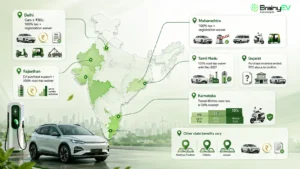
Delhi EV subsidy under the new EV Policy 2.0 (effective July 2026, running to March 2030) offers 100% road tax and registration fee exemption for electric cars priced up to ₹30 lakh (ex-showroom).
Additional Delhi EV subsidy details include:
- Purchase incentives for two-wheelers (₹30,000 in year one, tapering thereafter)
- Incentives for three-wheelers (₹50,000 in year one, tapering)
- A ₹1 lakh scrapping incentive for owners of BS-IV or older four-wheelers switching to an eligible EV
Maharashtra EV subsidy under the 2025-2030 policy provides 100% motor vehicle tax and registration fee exemption for all EVs until 2030. Direct purchase incentives are available mainly for commercial and fleet four-wheelers (up to ₹1.5-2 lakh, limited units), electric two-wheelers (up to ₹10,000) and three-wheelers (up to ₹30,000). Passenger EVs also receive toll exemptions on select major expressways.
Rajasthan EV subsidy remains active with purchase support (two-wheelers around ₹5,000 per kWh capped near ₹20,000; four-wheelers up to ₹1.5 lakh plus SGST elements in summaries) and 100% road tax exemption. Confirm current unit caps and the state portal for claims.
Tamil Nadu EV subsidy does not offer broad consumer cash incentives for private cars (focus is manufacturing-side). Buyers receive 100% road tax exemption until 31 December 2027, delivering meaningful on-road savings.
Gujarat EV subsidy direct purchase incentives under the earlier policy have been discontinued. The reduced 1% motor vehicle tax concession ended in March 2026. A new comprehensive policy with possible zero RTO tax is under discussion; current buyers should confirm exact RTO treatment at registration.
Karnataka EV subsidy offers no direct consumer cash incentive for private cars (support is largely manufacturer-oriented). The earlier full road tax exemption was rolled back in April 2026. New registrations now attract a tiered lifetime road tax of 5% (up to ₹10 lakh), 8% (₹10-25 lakh) or 10% (above ₹25 lakh). Electric two-wheelers remain exempt.
Other states continue to update their State EV policy frameworks. Benefits such as road tax relief or limited purchase incentives appear in places like Madhya Pradesh, Odisha and Assam, but always check live status, price caps, vehicle category limits and registration requirements.
Planning an EV journey or looking for reliable charging stations, trip-planning tools, and seasonal driving guides? BrainyEV brings the full electric vehicle ecosystem together in one trusted platform. Be it stations, trip planning, charging solutions or any practical ownership support.
Explore BrainyEV today to make every EV kilometre smoother.
How The State Benefits Are Applied
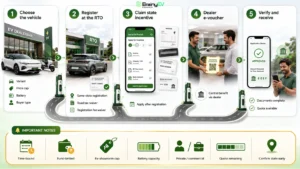
Road tax exemptions and registration fee waivers are normally reflected at the RTO during registration when the vehicle is registered in the same state. Purchase incentives, where available, are often claimed via the state EV portal after registration (invoice with chassis/VIN details, RC, bank details matching the buyer). Keep documents clear and complete. Central incentives that still apply are handled at the dealer via e-voucher where relevant.
Practical points to note:
- Policies are time-bound and fund-limited.
- Eligibility can depend on ex-showroom price, battery capacity, buyer type (private vs commercial) and remaining quotas.
- Confirm the exact variant and registration state early.
Thinking of buying an EV?
Before you make the switch, head to BrainyEV to compare EVs, understand real-world range, explore charging availability, plan long-distance journeys, and discover what everyday EV ownership is actually like.
Visit BrainyEV today and drive with confidence.
The combination of the Central EV subsidy framework (mainly GST and residual three-wheeler support) and strong State EV policy measures on tax and fees continues to lower the entry cost of electric mobility.
Check the latest official notifications for Delhi EV subsidy, Maharashtra EV subsidy, Rajasthan EV subsidy, Tamil Nadu EV subsidy, Gujarat EV subsidy and Karnataka EV subsidy details relevant to your registration state, and you can move forward with clear numbers.
You May Also Like:
Haryana Electric Vehicle Policy 2026