Indians are steadily embracing electric cars as fuel prices fluctuate and awareness of cleaner mobility grows. Many buyers wonder whether the lower running expenses truly offset other costs and what electric vehicle maintenance actually involves. Here’s a clear, research-backed look at the facts so you can decide what fits your driving pattern, charging access and budget.
Do Electric Cars Require Servicing?
Yes. Like any vehicle on Indian roads, electric cars need regular professional checks to stay safe and reliable. The difference lies in frequency and complexity. Electric drive trains contain far fewer moving parts than conventional engines, typically around 20 versus more than 2,000, so there are no oil changes, spark plugs, fuel filters or exhaust-system work.
Authorised service centres and industry bodies note that EV maintenance usually centres on an annual inspection. Technicians focus on tyres, brakes, suspension, cabin filters, software updates, battery health and general safety systems. Regenerative braking further reduces pad and disc wear, especially in stop-and-go city traffic. Still, annual servicing remains essential for warranty validity and long-term performance.
What Are the Main Areas That Need Maintenance?
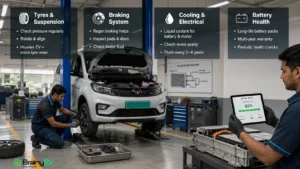
Several components require attention even though overall demands are lower.
- Tyres and suspension:
Battery electric vehicles (BEVs) are heavier because of the battery pack. This extra weight means tyres and suspension components work harder, particularly on uneven Indian roads. Regular pressure checks, rotation and alignment help extend tyre life.
- Braking system:
Regenerative braking means mechanical brakes are used less often, yet pads, discs and fluid still need periodic inspection.
- Cooling and electrical systems:
Electric drive trains use dedicated liquid coolant loops to manage battery and motor temperatures. While levels are inspected annually, full coolant flushes are typically required only every 2 to 4 years (depending on OEM schedules).
- Battery health:
Modern packs are designed for longevity and come with multi-year warranties (commonly eight years or a high kilometre limit). Periodic diagnostic checks monitor state of health.
These points illustrate that electric vehicle maintenance is simpler and more predictable, yet still important for safety and residual value.
What about Running and Maintenance Costs?
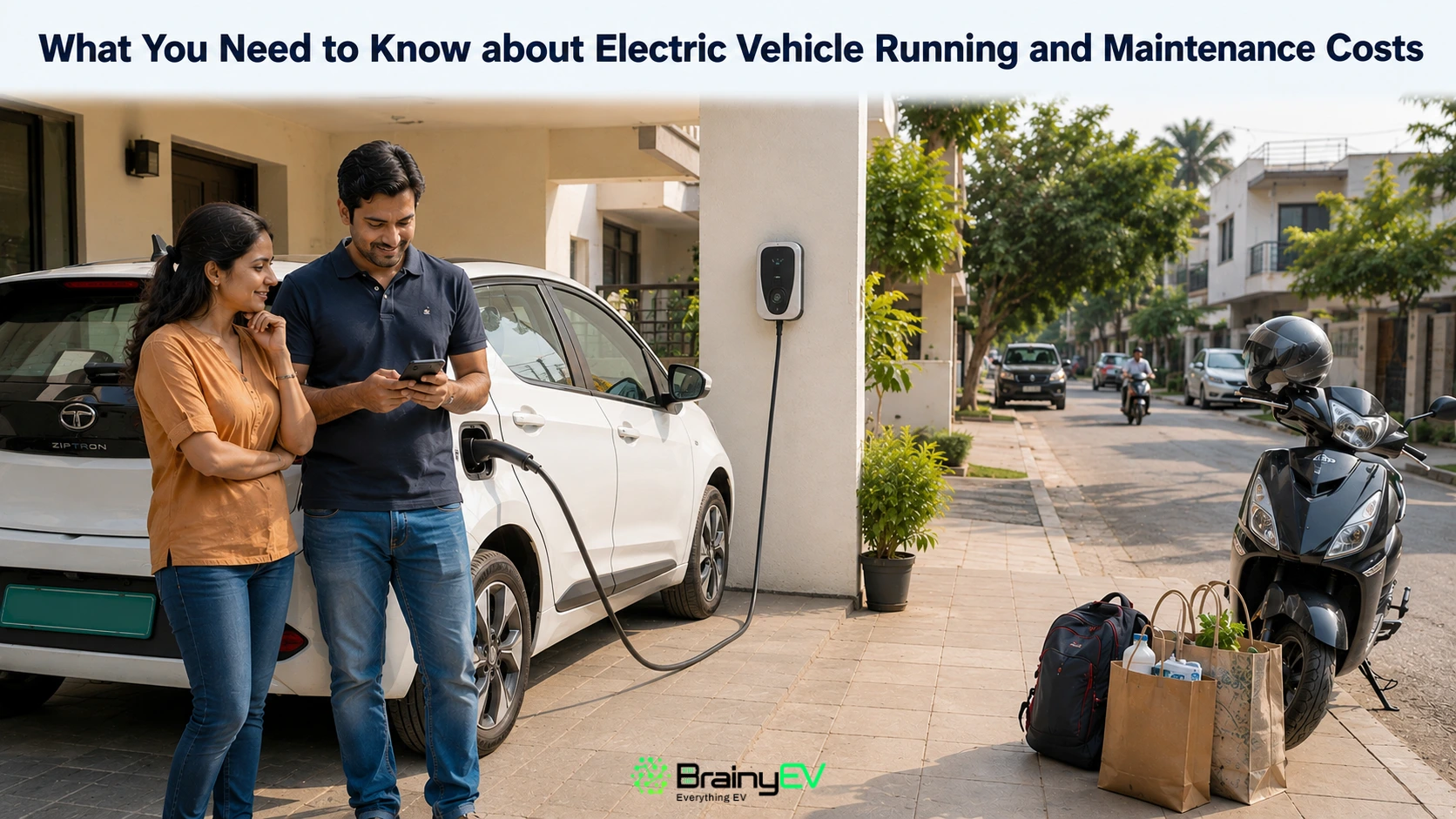
Running costs form one of the clearest advantages of electric cars for Indian owners. At typical residential electricity rates of ₹6-₹10 per unit, battery electric vehicles (BEVs) commonly travel for roughly ₹0.80-₹1.50 per kilometre when charged at home or the workplace.
Petrol vehicles, by comparison, often cost ₹6-₹9 per kilometre at current fuel prices. The gap means owners can see meaningful monthly savings on energy, and those who rely mainly on home or workplace charging capture the most consistent benefit.
Public fast-charging rates are higher, so the overall running-cost picture depends on each driver’s mix of home and public charging.
EV maintenance costs are also lower. Industry estimates and owner data show annual scheduled service bills for popular models commonly fall in the ₹3,000-₹7,000 range, roughly 40-70 percent less than equivalent petrol or diesel vehicles.
Over several years this difference can add up to tens of thousands of rupees, largely because electric drive trains eliminate many traditional consumables such as engine oil, spark plugs and exhaust components.
Tyres remain a notable expense due to the extra weight of the battery pack, and insurance premiums may be slightly higher because of the elevated insured value. Even so, the overall ownership arithmetic continues to favour electric cars for many Indian households.
Exact figures naturally vary with local electricity tariff slabs, charging habits, labour rates and driving style. Home-charging access therefore remains one of the practical factors readers can weigh when assessing how the numbers apply to their own situation.
Common Misconceptions and Practical Tips
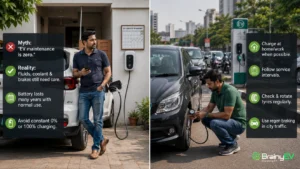
One frequent misconception is that electric car maintenance is zero. While far simpler, fluids such as brake fluid and gearbox oil (in the reduction gear) still need scheduled attention, and coolant loops must be maintained. Another concern centres on battery longevity. Real-world data and manufacturer warranties indicate that modern packs retain the large majority of capacity over many years under normal use; extreme heat, repeated deep discharges or constant 100% charging can accelerate degradation, so moderate charging habits help.
To keep costs low and range healthy:
- Prefer home or workplace charging whenever possible.
- Follow the manufacturer’s service intervals even if visits feel infrequent.
- Monitor tyre pressure and rotate regularly.
- Avoid consistently running the battery to empty or charging to 100 percent.
- Use regenerative braking modes in city traffic.
These habits support both electric vehicle maintenance schedules and long-term battery health.
Choosing the right electric cars ultimately depends on your specific circumstances, daily distance, access to reliable charging, parking situation and budget. Some drivers prioritise compact hatchbacks for city runs; others prefer SUVs for family needs or higher range.
The data consistently shows that battery electric vehicles (BEVs) deliver meaningfully lower running costs and simpler EV maintenance when the ownership pattern aligns with home charging and moderate-to-high annual kilometres. As India’s charging network expands and more models enter the market, the practical advantages of electric drive trains become clearer for a growing number of households.
For clear guidance on evaluating electric vehicle maintenance needs, running-cost calculators and model comparisons tailored to Indian conditions, explore the resources at BrainyEV.
You May Also Like:
How Much Does It Actually Cost to Charge an EV in Delhi?
Home Charging vs Public Charging